Matrix Utility Functions — IS_SYMMETRIC, IS_POSITIVE_DEFINITE, SYMMETRIZE, ORTHOGONALIZE, PSEUDO_INVERSE
This example exercises the five IMSL-compatible matrix utility functions:
eigensystems.is_symmetric()— checks \(\max|A - A^H| < \varepsilon\)eigensystems.is_positive_definite()— attempts Cholesky decompositioneigensystems.symmetrize()— returns the Hermitian part \((A + A^H)/2\); verified witheigensystems.is_symmetric()eigensystems.orthogonalize()— economy QR delivers orthonormal columns; verified via \(\|Q^T Q - I\|_\infty\)eigensystems.pseudo_inverse()— Moore–Penrose pseudo-inverse of a rank-deficient matrix; verified via \(\|A \cdot A^+ \cdot A - A\|_\infty\)
Example Code
"""IMSL matrix utility examples: is_symmetric, is_positive_definite,
symmetrize, orthogonalize, pseudo_inverse.

Demonstrates:
- is_symmetric and is_positive_definite on various matrices
- symmetrize: asymmetric → symmetric, verify result
- orthogonalize: 4 random vectors → orthonormal, verify Q^T Q = I
- pseudo_inverse: rank-deficient matrix, verify A @ pinv(A) @ A = A

Outputs:
- Boolean check results and reconstruction errors
- SVG heatmaps: before/after for symmetrize and orthogonalize
- Save SVG to test_output/example_imsl_matrix_utils.svg
- Console output captured to docs/_generated_text/matrix_utils_output.txt
"""
from __future__ import annotations

from pathlib import Path

import matplotlib
matplotlib.use("Agg")
import matplotlib.pyplot as plt
import numpy as np

from eigensystems import (
    is_positive_definite,
    is_symmetric,
    orthogonalize,
    pseudo_inverse,
    symmetrize,
)


def run_demo_matrix_utils() -> dict:
    """Run all matrix utility demonstrations.

    Args:
        None

    Returns:
        dict: Keys ``sym_result`` (np.ndarray), ``Q`` (np.ndarray),
            ``pinv_A`` (np.ndarray), ``orth_err`` (float),
            ``pinv_err`` (float), ``plot_path`` (str).
    """
    # ------------------------------------------------------------------
    # is_symmetric / is_positive_definite — multiple test matrices
    # ------------------------------------------------------------------
    S_sym = np.array([[4.0, 2.0, 1.0],
                      [2.0, 5.0, 3.0],
                      [1.0, 3.0, 6.0]])           # symmetric SPD

    S_asym = np.array([[1.0, 2.0, 3.0],
                       [0.0, 4.0, 5.0],
                       [0.0, 0.0, 6.0]])           # upper triangular, not symmetric

    S_indef = np.array([[ 1.0, 2.0],
                        [ 2.0, -1.0]])             # indefinite

    S_herm = np.array([[3.0 + 0j,  1.0 + 2j],
                       [1.0 - 2j,  5.0 + 0j]])    # complex Hermitian

    print("\nIMSL IS_SYMMETRIC / IS_POSITIVE_DEFINITE Checks")
    print("-" * 55)
    matrices = {
        "S_sym   (3×3 SPD)":    S_sym,
        "S_asym  (upper tri)":  S_asym,
        "S_indef (indefinite)": S_indef,
        "S_herm  (Hermitian)":  S_herm,
    }
    for name, mat in matrices.items():
        sym = is_symmetric(mat)
        spd = is_positive_definite(mat)
        print(f"  {name:<28}  is_symmetric={sym!s:<5}  is_positive_definite={spd!s}")

    # ------------------------------------------------------------------
    # symmetrize — make an asymmetric matrix symmetric
    # ------------------------------------------------------------------
    A_raw = np.array([[1.0, 4.0, 7.0],
                      [2.0, 5.0, 8.0],
                      [3.0, 6.0, 9.0]])

    A_sym = symmetrize(A_raw)
    sym_error = np.max(np.abs(A_sym - A_sym.T))

    print("\nIMSL SYMMETRIZE Example")
    print("Original (asymmetric):")
    print(A_raw)
    print("Symmetrized (A + A^T)/2:")
    print(A_sym)
    print(f"Max asymmetry after symmetrize: {sym_error:.2e}  (should be ~0)")
    print(f"is_symmetric(symmetrize(A_raw)) = {is_symmetric(A_sym)}")

    # ------------------------------------------------------------------
    # orthogonalize — 4 random 6-D vectors → orthonormal Q
    # ------------------------------------------------------------------
    rng = np.random.default_rng(7)
    V_raw = rng.standard_normal((6, 4))  # 6 rows, 4 columns

    Q = orthogonalize(V_raw)
    orth_err = np.max(np.abs(Q.T @ Q - np.eye(4)))

    print("\nIMSL ORTHOGONALIZE Example")
    print(f"Input V shape: {V_raw.shape}  →  Q shape: {Q.shape}")
    print(f"Q^T Q ≈ I, max error = {orth_err:.2e}  (should be ~0)")

    # ------------------------------------------------------------------
    # pseudo_inverse — rank-deficient 3×4 matrix
    # ------------------------------------------------------------------
    # Rank-2 matrix: columns 3 and 4 are linear combinations of 1 and 2
    C = np.array([
        [1.0, 0.0,  1.0,  2.0],
        [0.0, 1.0,  1.0, -1.0],
        [1.0, 1.0,  2.0,  1.0],
    ])
    C_pinv = pseudo_inverse(C)
    recon_err = np.max(np.abs(C @ C_pinv @ C - C))

    print("\nIMSL PSEUDO_INVERSE Example")
    print(f"C shape: {C.shape},  pseudo_inverse shape: {C_pinv.shape}")
    print(f"Reconstruction error ‖C @ pinv(C) @ C - C‖_max = {recon_err:.2e}")
    # Verify rank
    from eigensystems import matrix_rank
    print(f"matrix_rank(C) = {matrix_rank(C)}  (expected 2)")

    # ------------------------------------------------------------------
    # Plot: four heatmaps — A_raw, A_sym, V_raw columns, Q columns
    # ------------------------------------------------------------------
    output_dir = Path("test_output")
    output_dir.mkdir(parents=True, exist_ok=True)
    plot_path = output_dir / "example_imsl_matrix_utils.svg"

    fig, axes = plt.subplots(2, 2, figsize=(13, 10))
    cmap = "RdBu_r"

    def _heatmap(ax: object, data: np.ndarray, title: str) -> None:
        """Draw a labelled heatmap on ax.

        Args:
            ax: Matplotlib Axes object.
            data (np.ndarray): 2-D array to visualise.
            title (str): Axes title.
        """
        im = ax.imshow(data, cmap=cmap, aspect="auto")
        fig.colorbar(im, ax=ax, fraction=0.046)
        ax.set_title(title)
        ax.set_xlabel("Column")
        ax.set_ylabel("Row")
        for i in range(data.shape[0]):
            for j in range(data.shape[1]):
                val = data[i, j]
                ax.text(j, i, f"{val:.2f}", ha="center", va="center",
                        fontsize=7,
                        color="white" if abs(val) > 0.5 * np.max(np.abs(data)) else "black")

    _heatmap(axes[0, 0], A_raw, "Before SYMMETRIZE\n(asymmetric A_raw)")
    _heatmap(axes[0, 1], A_sym, "After SYMMETRIZE\n(A + A^T)/2")
    _heatmap(axes[1, 0], V_raw, "Before ORTHOGONALIZE\n(random 6×4 V)")
    _heatmap(axes[1, 1], Q,     "After ORTHOGONALIZE\n(Q — orthonormal columns)")

    fig.suptitle("Matrix Utility Functions — IMSL Routines", fontsize=13,
                 fontweight="bold")
    fig.tight_layout()
    fig.savefig(plot_path, format="svg")
    plt.close(fig)
    print(f"\nPlot saved: {plot_path}")

    return {
        "sym_result": A_sym,
        "Q": Q,
        "pinv_A": C_pinv,
        "orth_err": float(orth_err),
        "pinv_err": float(recon_err),
        "plot_path": str(plot_path),
    }


if __name__ == "__main__":
    run_demo_matrix_utils()
Plot Output
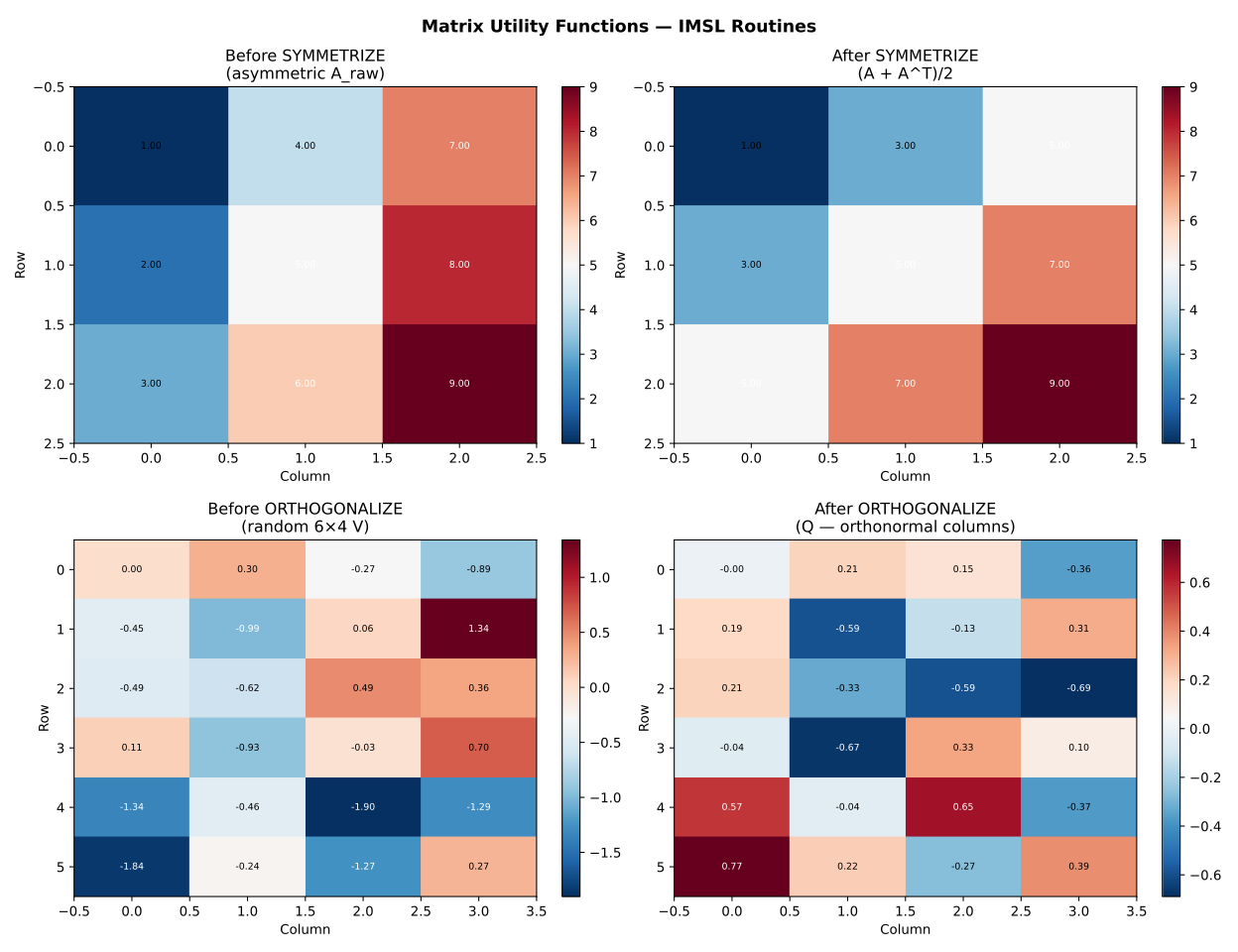
Top row: asymmetric matrix A (left) and its symmetrized form (right). Bottom row: random 6×4 matrix V (left) and orthonormal Q (right).
Console Output
IMSL IS_SYMMETRIC / IS_POSITIVE_DEFINITE Checks
-------------------------------------------------------
  S_sym   (3×3 SPD)             is_symmetric=True   is_positive_definite=True
  S_asym  (upper tri)           is_symmetric=False  is_positive_definite=True
  S_indef (indefinite)          is_symmetric=True   is_positive_definite=False
  S_herm  (Hermitian)           is_symmetric=True   is_positive_definite=True

IMSL SYMMETRIZE Example
Original (asymmetric):
[[1. 4. 7.]
 [2. 5. 8.]
 [3. 6. 9.]]
Symmetrized (A + A^T)/2:
[[1. 3. 5.]
 [3. 5. 7.]
 [5. 7. 9.]]
Max asymmetry after symmetrize: 0.00e+00  (should be ~0)
is_symmetric(symmetrize(A_raw)) = True

IMSL ORTHOGONALIZE Example
Input V shape: (6, 4)  →  Q shape: (6, 4)
Q^T Q Γëê I, max error = 5.55e-16  (should be ~0)

IMSL PSEUDO_INVERSE Example
C shape: (3, 4),  pseudo_inverse shape: (4, 3)
Reconstruction error ΓÇûC @ pinv(C) @ C - CΓÇû_max = 1.33e-15
matrix_rank(C) = 2  (expected 2)

Plot saved: test_output\example_imsl_matrix_utils.svg