Condition Number Example — Matrix Conditioning and Stability
This example builds a sequence of matrices whose spectral condition numbers range from 1 (perfectly conditioned) to 10¹² (nearly singular) and studies the effect on linear system solve accuracy.
Key functions used:
eigensystems.condition_number()— spectral condition number κ(A)eigensystems.matrix_norm()— 2-norm ‖A‖₂
A right-hand side perturbed by Gaussian noise of magnitude 10⁻⁸ is used to expose how the relative solution error grows proportionally to κ(A).
Example Code
"""IMSL condition number example: matrix conditioning and linear system stability.

Demonstrates:
- Create matrices with a range of condition numbers (well- to ill-conditioned).
- Compute condition numbers via :func:`eigensystems.condition_number`.
- Compute matrix norms via :func:`eigensystems.matrix_norm`.
- Solve perturbed linear systems and measure solution error.
- Plot solution error vs condition number on a log-log scale.
- Save to test_output/example_imsl_condition_number.svg

Outputs:
- Printed table of condition numbers and solution errors.
- SVG figure saved to test_output/.
- Console output captured to docs/_generated_text/condition_number_output.txt
"""
from __future__ import annotations

from pathlib import Path

import matplotlib
matplotlib.use("Agg")
import matplotlib.pyplot as plt
import numpy as np

from eigensystems import condition_number, matrix_norm


def _build_matrix(n: int, cond_target: float) -> np.ndarray:
    """Build an n×n matrix with approximate condition number cond_target.

    Uses a diagonal matrix with singular values spread logarithmically
    from 1 to cond_target, then applies random orthogonal transforms.

    Args:
        n (int): Matrix dimension.
        cond_target (float): Desired spectral condition number (σ_max/σ_min).

    Returns:
        np.ndarray: Real matrix of shape (n, n) with condition ≈ cond_target.
    """
    rng = np.random.default_rng(seed=int(cond_target))
    singular_vals = np.logspace(0, np.log10(cond_target), n)
    Q1, _ = np.linalg.qr(rng.standard_normal((n, n)))
    Q2, _ = np.linalg.qr(rng.standard_normal((n, n)))
    return Q1 @ np.diag(singular_vals) @ Q2.T


def run_demo_condition_number() -> dict:
    """Run IMSL condition number example: effect on linear system accuracy.

    Builds matrices with condition numbers from 1 to 1e12, solves Ax=b with
    a small right-hand-side perturbation, and measures the resulting solution
    error.

    Args:
        None

    Returns:
        dict: Result dictionary with keys ``cond_numbers`` (list[float]),
            ``errors`` (list[float]), and ``plot_path`` (str).
    """
    n = 6
    target_conds = [1.0, 10.0, 1e2, 1e4, 1e6, 1e8, 1e10, 1e12]
    cond_numbers: list[float] = []
    norms: list[float] = []
    errors: list[float] = []

    rng = np.random.default_rng(0)
    x_true = np.ones(n)
    perturbation_scale = 1e-8

    print("\nIMSL Condition Number Example: Linear System Stability")
    print("-" * 72)
    print(f"{'Target κ':>12}  {'Actual κ':>14}  {'||A||₂':>12}  {'||Δx||/||x||':>14}")
    print("-" * 72)

    for target in target_conds:
        A = _build_matrix(n, target)
        b_exact = A @ x_true
        # Perturb b to simulate noise
        b_perturbed = b_exact + perturbation_scale * rng.standard_normal(n)

        kappa = condition_number(A)
        norm_a = matrix_norm(A, ord=2)
        try:
            x_computed = np.linalg.solve(A, b_perturbed)
            rel_err = float(np.linalg.norm(x_computed - x_true) / np.linalg.norm(x_true))
        except np.linalg.LinAlgError:
            rel_err = float("nan")

        cond_numbers.append(kappa)
        norms.append(norm_a)
        errors.append(rel_err)
        print(f"  {target:>12.1e}  {kappa:>14.4e}  {norm_a:>12.4e}  {rel_err:>14.4e}")

    print("-" * 72)

    output_dir = Path("test_output")
    output_dir.mkdir(parents=True, exist_ok=True)
    plot_path = output_dir / "example_imsl_condition_number.svg"

    finite_mask = [not np.isnan(e) for e in errors]
    kappa_plot = [k for k, m in zip(cond_numbers, finite_mask) if m]
    err_plot = [e for e, m in zip(errors, finite_mask) if m]

    fig, axes = plt.subplots(1, 2, figsize=(12, 5))
    fig.suptitle(
        "IMSL condition_number / matrix_norm: Effect of Condition Number on Solve Accuracy",
        fontsize=11,
    )

    ax = axes[0]
    ax.loglog(kappa_plot, err_plot, "o-", color="#be123c", linewidth=1.8,
               markersize=7, markerfacecolor="#fecdd3", markeredgecolor="#be123c")
    ax.set_xlabel("Condition number κ(A)  [log scale]")
    ax.set_ylabel("Relative solution error ||Δx||/||x||  [log scale]")
    ax.set_title("Solution Error vs Condition Number")
    ax.grid(True, which="both", linestyle="--", alpha=0.5)

    ax = axes[1]
    ax.semilogx(kappa_plot, norms, "s-", color="#0369a1", linewidth=1.8,
                markersize=7, markerfacecolor="#bae6fd", markeredgecolor="#0369a1")
    ax.set_xlabel("Condition number κ(A)  [log scale]")
    ax.set_ylabel("2-norm ||A||₂")
    ax.set_title("Matrix 2-Norm vs Condition Number")
    ax.grid(True, which="both", linestyle="--", alpha=0.5)

    fig.tight_layout()
    fig.savefig(plot_path, format="svg")
    plt.close(fig)
    print(f"\nPlot saved: {plot_path}")

    return {
        "cond_numbers": cond_numbers,
        "errors": errors,
        "plot_path": str(plot_path),
    }


if __name__ == "__main__":
    run_demo_condition_number()
Plot Output
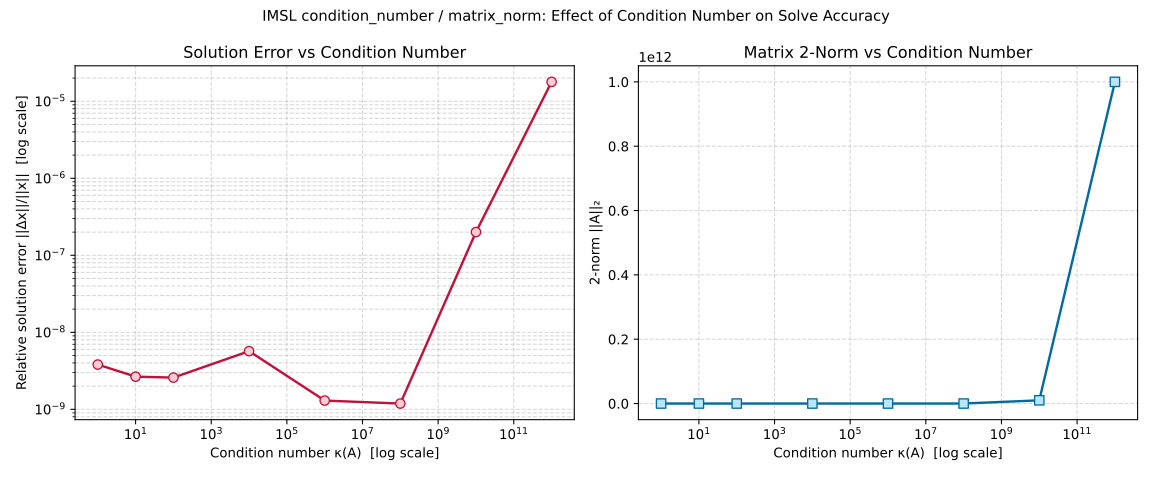
Left: relative solution error ‖Δx‖/‖x‖ vs condition number on a log-log scale — the near-linear trend confirms the classical bound Δx/x ≤ κ·Δb/b. Right: 2-norm ‖A‖₂ vs condition number.
Console Output
IMSL Condition Number Example: Linear System Stability
------------------------------------------------------------------------
    Target κ        Actual κ        ||A||₂    ||Δx||/||x||
------------------------------------------------------------------------
       1.0e+00      1.0000e+00    1.0000e+00      3.8125e-09
       1.0e+01      1.0000e+01    1.0000e+01      2.6560e-09
       1.0e+02      1.0000e+02    1.0000e+02      2.5839e-09
       1.0e+04      1.0000e+04    1.0000e+04      5.6974e-09
       1.0e+06      1.0000e+06    1.0000e+06      1.2996e-09
       1.0e+08      1.0000e+08    1.0000e+08      1.1888e-09
       1.0e+10      1.0000e+10    1.0000e+10      2.0054e-07
       1.0e+12      1.0000e+12    1.0000e+12      1.7846e-05
------------------------------------------------------------------------

Plot saved: test_output\example_imsl_condition_number.svg