EVLSF Example — Toeplitz Matrix Eigenvalues
This example creates a 4x4 symmetric Toeplitz matrix and computes its
eigenvalues using eigensystems.evlsf() along with the spectral
condition number via eigensystems.condition_number().
Example Code
"""IMSL EVLSF example: eigenvalues of a symmetric Toeplitz matrix.

Reproduces the IMSL EVLSF style example:
- Create a 4x4 symmetric Toeplitz matrix.
- Compute eigenvalues with evlsf().
- Compute condition number with condition_number().
- Line plot of sorted eigenvalues.
- Save to test_output/example_imsl_evlsf.svg

Outputs:
- Printed table of eigenvalues and condition number
- SVG line plot saved to test_output/
"""
from __future__ import annotations

from pathlib import Path

import matplotlib
matplotlib.use("Agg")
import matplotlib.pyplot as plt
import numpy as np

from eigensystems import condition_number, evlsf


def run_demo_evlsf() -> dict:
    """Run IMSL EVLSF example: symmetric Toeplitz matrix eigenvalues.

    Creates a 4x4 symmetric Toeplitz matrix, computes its eigenvalues
    (which are real and ascending by definition of evlsf), computes the
    spectral condition number, and produces a line plot.

    Args:
        None

    Returns:
        dict: Result dictionary with keys ``eigenvalues`` (np.ndarray),
            ``condition`` (float), and ``plot_path`` (str).
    """
    # 4x4 symmetric Toeplitz: T[i,j] = 4 - |i-j|
    n = 4
    a = np.array([[4.0 - abs(i - j) for j in range(n)] for i in range(n)])

    result = evlsf(a)
    cond = condition_number(a)

    print("\nIMSL EVLSF Example: Symmetric Toeplitz Matrix Eigenvalues")
    print("Matrix T[i,j] = 4 - |i-j|:")
    for row in a:
        print("  " + "  ".join(f"{v:6.2f}" for v in row))
    print("-" * 50)
    print(f"{'Index':<8} {'Eigenvalue':>16}")
    print("-" * 50)
    for i, ev in enumerate(result.eigenvalues):
        print(f"  {i+1:<6} {ev:>16.8f}")
    print("-" * 50)
    print(f"  Condition number (2-norm): {cond:.6f}")
    print(f"  Sum of eigenvalues:        {np.sum(result.eigenvalues):.6f}")
    print(f"  Trace of A:                {np.trace(a):.6f}")

    output_dir = Path("test_output")
    output_dir.mkdir(parents=True, exist_ok=True)
    plot_path = output_dir / "example_imsl_evlsf.svg"

    fig, ax = plt.subplots(figsize=(7, 5))
    idx = np.arange(1, n + 1)
    ax.plot(idx, result.eigenvalues, "o-", color="#be123c", linewidth=2,
            markersize=9, markerfacecolor="#e11d48", markeredgecolor="#7f1d1d",
            label="Eigenvalues (evlsf)")
    ax.fill_between(idx, result.eigenvalues, alpha=0.15, color="#be123c")
    ax.set_xticks(idx)
    ax.set_xticklabels([f"λ{i}" for i in idx])
    ax.set_xlabel("Eigenvalue index (ascending)")
    ax.set_ylabel("Eigenvalue")
    ax.set_title(
        "IMSL EVLSF: Symmetric Toeplitz Matrix Eigenvalues\n"
        f"(condition number = {cond:.3f})"
    )
    ax.legend()
    ax.axhline(0, color="gray", linewidth=0.8, linestyle="--")
    fig.tight_layout()
    fig.savefig(plot_path, format="svg")
    plt.close(fig)
    print(f"\nPlot saved: {plot_path}")

    return {
        "eigenvalues": result.eigenvalues,
        "condition": cond,
        "plot_path": str(plot_path),
    }


if __name__ == "__main__":
    run_demo_evlsf()
Plot Output
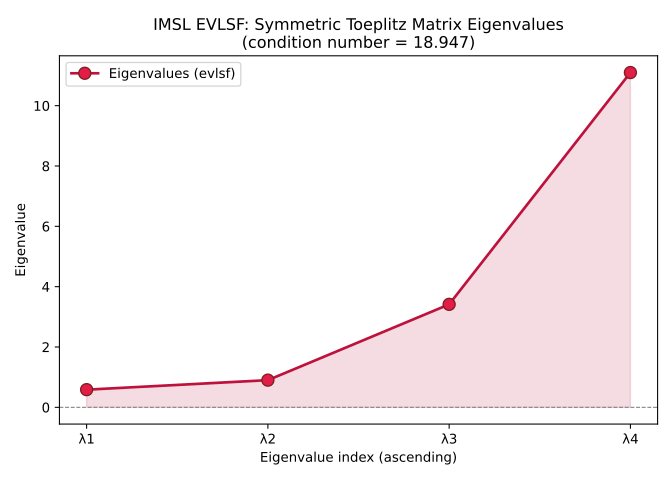
Eigenvalues of the 4x4 symmetric Toeplitz matrix, sorted in ascending order. The shaded region highlights the spectral range.
Console Output
IMSL EVLSF Example: Symmetric Toeplitz Matrix Eigenvalues
Matrix T[i,j] = 4 - |i-j|:
    4.00    3.00    2.00    1.00
    3.00    4.00    3.00    2.00
    2.00    3.00    4.00    3.00
    1.00    2.00    3.00    4.00
--------------------------------------------------
Index          Eigenvalue
--------------------------------------------------
  1            0.58578644
  2            0.90098049
  3            3.41421356
  4           11.09901951
--------------------------------------------------
  Condition number (2-norm): 18.947211
  Sum of eigenvalues:        16.000000
  Trace of A:                16.000000

Plot saved: test_output\example_imsl_evlsf.svg