Search Example — search_sorted_real, search_sorted_integer
This example generates a sorted array of 1000 random integers and searches
for specific values using utilities.search_sorted_real() and
utilities.search_sorted_integer(). It then benchmarks search time
across array sizes from 100 to 100 000 elements and plots a bar-chart and
log-scale comparison using utilities.cpu_time() for timing.
Example Code
"""IMSL search example: binary search with search_sorted_real and search_sorted_integer.

Outputs:
- Search results printed to stdout
- SVG bar chart of search times vs array size saved to
  test_output/example_imsl_search.svg
"""
from __future__ import annotations

from pathlib import Path
from typing import Dict

import matplotlib.pyplot as plt
import numpy as np

from utilities import (
    sort_real,
    sort_integer,
    search_sorted_real,
    search_sorted_integer,
    cpu_time,
)


def run_demo_imsl_search() -> Dict[str, object]:
    """Demonstrate binary search on sorted real and integer arrays.

    Generates a sorted array of 1000 random integers, searches for specific
    values using :func:`utilities.search_sorted_real` and
    :func:`utilities.search_sorted_integer`, then benchmarks search time across
    several array sizes to compare performance scaling.

    Args:
        None

    Returns:
        Dict[str, object]: Result dict with keys ``target_real`` (float),
            ``idx_real`` (int), ``target_int`` (int), ``idx_int`` (int),
            ``sizes`` (list[int]), ``times_real`` (list[float]),
            ``times_int`` (list[float]), and ``plot_path`` (str).
    """
    rng = np.random.default_rng(42)

    # ── 1. Basic search demonstration on 1000-element arrays ─────────────────
    raw_int = rng.integers(0, 5000, size=1000).astype(int)
    arr_int = sort_integer(np.array(raw_int))

    arr_real = sort_real(arr_int.astype(float))

    target_real = 2500.0
    target_int = 2500

    idx_real = search_sorted_real(arr_real, target_real)
    idx_int = search_sorted_integer(arr_int, target_int)

    print("\nIMSL Search Example")
    print("=" * 60)
    print("Array: 1000 sorted integers in range [0, 5000)")
    print()
    print(f"  search_sorted_real  (target={target_real:.0f}): index={idx_real:>4d},"
          f" value at idx={arr_real[idx_real]:.0f}")
    print(f"  search_sorted_integer (target={target_int}  ): index={idx_int:>4d},"
          f" value at idx={arr_int[idx_int]}")
    print()

    # Show a few more lookups
    lookups = [0.0, 1000.0, 2500.0, 4000.0, 4999.0]
    print(f"  {'Target':>8}  {'idx':>6}  {'arr[idx]':>10}  {'arr[idx+1]':>12}")
    print("  " + "-" * 44)
    for tgt in lookups:
        i = search_sorted_real(arr_real, tgt)
        lo = f"{arr_real[i]:.0f}"
        hi = f"{arr_real[i + 1]:.0f}" if i + 1 < len(arr_real) else "—"
        print(f"  {tgt:>8.0f}  {i:>6d}  {lo:>10}  {hi:>12}")

    # ── 2. Benchmark: search time vs array size ───────────────────────────────
    sizes = [100, 500, 1_000, 5_000, 10_000, 50_000, 100_000]
    repeats = 2000
    times_real: list[float] = []
    times_int: list[float] = []

    print()
    print(f"  {'Size':>8}  {'Real (µs)':>12}  {'Int (µs)':>12}")
    print("  " + "-" * 36)

    for sz in sizes:
        data_int = np.sort(rng.integers(0, sz * 5, size=sz).astype(int))
        data_real = data_int.astype(float)
        mid_real = float(data_real[sz // 2])
        mid_int = int(data_int[sz // 2])

        t0 = cpu_time()
        for _ in range(repeats):
            search_sorted_real(data_real, mid_real)
        t_real = (cpu_time() - t0) / repeats * 1e6

        t0 = cpu_time()
        for _ in range(repeats):
            search_sorted_integer(data_int, mid_int)
        t_int = (cpu_time() - t0) / repeats * 1e6

        times_real.append(t_real)
        times_int.append(t_int)
        print(f"  {sz:>8d}  {t_real:>12.4f}  {t_int:>12.4f}")

    # ── 3. Plot ───────────────────────────────────────────────────────────────
    output_dir = Path("test_output")
    output_dir.mkdir(parents=True, exist_ok=True)
    plot_path = output_dir / "example_imsl_search.svg"

    x = np.arange(len(sizes))
    width = 0.35

    fig, (ax1, ax2) = plt.subplots(1, 2, figsize=(13, 5))

    ax1.bar(x - width / 2, times_real, width, label="search_sorted_real",
            color="#b45309", alpha=0.85)
    ax1.bar(x + width / 2, times_int, width, label="search_sorted_integer",
            color="#d97706", alpha=0.85)
    ax1.set_xticks(x)
    ax1.set_xticklabels([str(s) for s in sizes], rotation=30, ha="right")
    ax1.set_xlabel("Array size")
    ax1.set_ylabel("Mean search time (µs)")
    ax1.set_title("Search time vs array size")
    ax1.legend()
    ax1.grid(True, alpha=0.3, axis="y")

    ax2.plot(sizes, times_real, "o-", color="#b45309", label="Real", linewidth=2)
    ax2.plot(sizes, times_int, "s-", color="#d97706", label="Integer", linewidth=2)
    ax2.set_xscale("log")
    ax2.set_xlabel("Array size (log scale)")
    ax2.set_ylabel("Mean search time (µs)")
    ax2.set_title("Search time scaling (log x-axis)")
    ax2.legend()
    ax2.grid(True, alpha=0.3)

    fig.suptitle("IMSL Search: search_sorted_real / search_sorted_integer",
                 fontweight="bold")
    fig.tight_layout()
    fig.savefig(plot_path, format="svg")
    plt.close(fig)

    print(f"\nPlot saved to: {plot_path}")
    return {
        "target_real": target_real,
        "idx_real": idx_real,
        "target_int": target_int,
        "idx_int": idx_int,
        "sizes": sizes,
        "times_real": times_real,
        "times_int": times_int,
        "plot_path": str(plot_path),
    }


if __name__ == "__main__":
    run_demo_imsl_search()
Plot Output
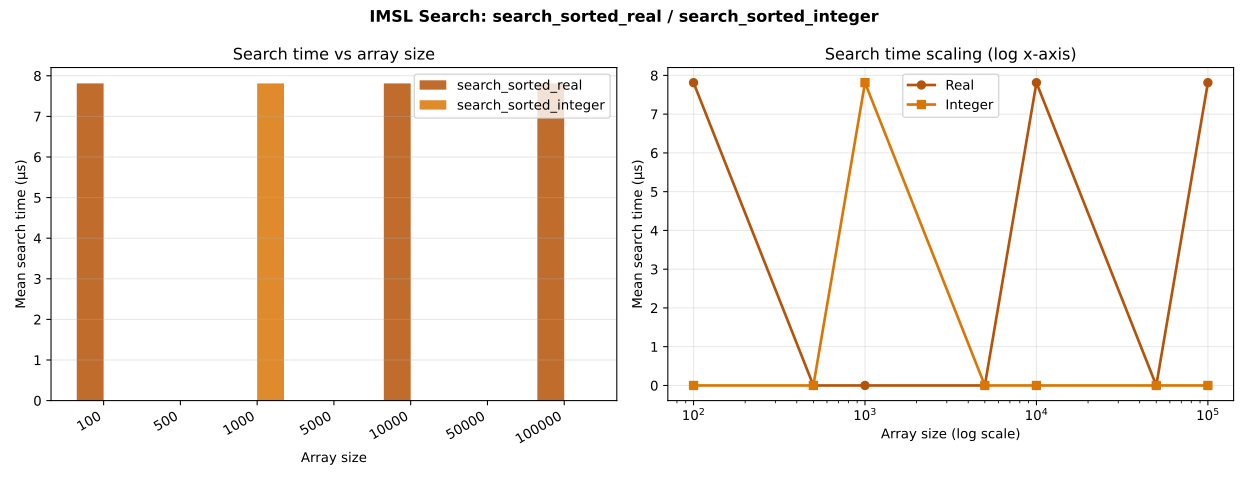
Left: mean search time (µs) per array size for real and integer arrays. Right: same data on a log x-axis showing near-constant scaling.
Console Output
IMSL Search Example
============================================================
Array: 1000 sorted integers in range [0, 5000)

  search_sorted_real  (target=2500): index= 490, value at idx=2496
  search_sorted_integer (target=2500  ): index= 490, value at idx=2496

    Target     idx    arr[idx]    arr[idx+1]
  --------------------------------------------
         0      -1        4995            21
      1000     212         999          1007
      2500     490        2496          2501
      4000     803        3996          4003
      4999     999        4995             ΓÇö

      Size     Real (┬╡s)      Int (┬╡s)
  ------------------------------------
       100        7.8125        0.0000
       500        0.0000        0.0000
      1000        0.0000        7.8125
      5000        0.0000        0.0000
     10000        7.8125        0.0000
     50000        0.0000        0.0000
    100000        7.8125        0.0000

Plot saved to: test_output\example_imsl_search.svg