Numerical Utilities Example — hypot_safe, prime_factors, cpu_time
This example exercises three miscellaneous IMSL utility functions:
utilities.hypot_safe() for overflow-safe hypotenuse computation
(including extreme values such as 10²⁰⁰),
utilities.prime_factors() for integer factorisation, and
utilities.cpu_time() (IMSL CPSEC) for CPU-time measurement.
Machine constants (epsilon, float max, float min) are read from
numpy and floating-point precision is visualised as relative
rounding error vs magnitude, alongside a float32-vs-float64 comparison.
Example Code
"""IMSL numerical utilities example: hypot_safe, prime_factors, cpu_time,
and floating-point precision analysis.

Outputs:
- Machine constants and results printed to stdout
- SVG floating-point precision visualisation saved to
  test_output/example_imsl_numerical_utils.svg
"""
from __future__ import annotations

import sys
from pathlib import Path
from typing import Dict

import matplotlib.pyplot as plt
import numpy as np

from utilities import hypot_safe, prime_factors, cpu_time, cpu_time as cpsec


def run_demo_imsl_numerical_utils() -> Dict[str, object]:
    """Demonstrate numerical utility functions and floating-point properties.

    Uses :func:`utilities.hypot_safe` for overflow-safe hypotenuse
    computation, :func:`utilities.prime_factors` for integer factorisation,
    and :func:`utilities.cpu_time` (IMSL CPSEC) for timing.  Computes
    machine epsilon and float limits from numpy and visualises relative
    rounding error as a function of magnitude.

    Args:
        None

    Returns:
        Dict[str, object]: Result dict with keys ``machine_eps`` (float),
            ``float_max`` (float), ``float_min`` (float),
            ``hypot_results`` (list), ``factored`` (dict),
            and ``plot_path`` (str).
    """
    # ── Machine constants ─────────────────────────────────────────────────────
    finfo = np.finfo(np.float64)
    machine_eps = float(finfo.eps)
    float_max = float(finfo.max)
    float_min = float(finfo.tiny)

    print("\nIMSL Numerical Utilities Example")
    print("=" * 55)
    print("\n  Machine Constants (float64 / IEEE 754 double)")
    print(f"  {'Machine epsilon':<28}  {machine_eps:.6e}")
    print(f"  {'Float max':<28}  {float_max:.6e}")
    print(f"  {'Float min (tiny)':<28}  {float_min:.6e}")
    print(f"  {'Mantissa bits':<28}  {finfo.nmant}")
    print(f"  {'Decimal digits':<28}  {finfo.precision}")
    print(f"  {'Python sys.float_info.epsilon':<28}  {sys.float_info.epsilon:.6e}")

    # ── hypot_safe examples ───────────────────────────────────────────────────
    hypot_cases = [
        (3.0, 4.0),
        (5.0, 12.0),
        (1e200, 1e200),   # would overflow with naive a^2+b^2
        (1e-200, 1e-200), # would underflow with naive approach
        (0.0, 7.3),
    ]
    hypot_results: list[dict] = []

    print("\n  hypot_safe — overflow/underflow-safe hypotenuse")
    print(f"  {'a':>12}  {'b':>12}  {'hypot_safe':>16}  {'naive ok?':>10}")
    print("  " + "-" * 56)
    for a, b in hypot_cases:
        h = hypot_safe(a, b)
        try:
            naive = (a**2 + b**2) ** 0.5
            naive_ok = "yes" if np.isfinite(naive) else "overflow"
        except OverflowError:
            naive_ok = "overflow"
        hypot_results.append({"a": a, "b": b, "hypot": h})
        print(f"  {a:>12.3e}  {b:>12.3e}  {h:>16.6e}  {naive_ok:>10}")

    # ── prime_factors examples ────────────────────────────────────────────────
    test_numbers = [12, 60, 100, 360, 1024, 9999, 97, 1000003]
    factored: dict[int, list[int]] = {}

    print("\n  prime_factors — integer factorisation")
    print(f"  {'n':>10}  {'factors'}")
    print("  " + "-" * 40)
    for n in test_numbers:
        factors = prime_factors(n)
        factored[n] = factors
        expr = " × ".join(str(f) for f in factors)
        print(f"  {n:>10d}  {expr}")

    # ── cpu_time / cpsec timing ───────────────────────────────────────────────
    t0 = cpu_time()
    _ = np.linalg.eig(np.random.default_rng(0).random((200, 200)))
    elapsed = cpu_time() - t0

    print(f"\n  cpu_time (CPSEC): eig(200×200) took {elapsed*1000:.3f} ms CPU time")

    # ── Floating-point precision visualisation ────────────────────────────────
    magnitudes = np.logspace(-15, 15, 300)
    rel_errors = np.array([
        abs((x + machine_eps * x) - x) / x if x != 0 else machine_eps
        for x in magnitudes
    ])

    # Round-trip through float32 to show precision loss
    mag32 = np.logspace(-6, 6, 200)
    x64 = mag32.astype(np.float64)
    x32 = mag32.astype(np.float32).astype(np.float64)
    rel_err32 = np.abs(x64 - x32) / (np.abs(x64) + 1e-300)

    output_dir = Path("test_output")
    output_dir.mkdir(parents=True, exist_ok=True)
    plot_path = output_dir / "example_imsl_numerical_utils.svg"

    fig, axes = plt.subplots(1, 3, figsize=(16, 5))

    # Panel 1: relative rounding error vs magnitude
    ax1 = axes[0]
    ax1.loglog(magnitudes, rel_errors, color="#b45309", linewidth=1.8,
               label=f"float64 ε={machine_eps:.1e}")
    ax1.axhline(machine_eps, color="gray", linewidth=1.0, linestyle="--",
                label="Machine epsilon")
    ax1.set_xlabel("Magnitude")
    ax1.set_ylabel("Relative rounding error")
    ax1.set_title("Float64 precision vs magnitude")
    ax1.legend(fontsize=8)
    ax1.grid(True, which="both", alpha=0.3)

    # Panel 2: float32 vs float64 relative error
    ax2 = axes[1]
    ax2.semilogy(mag32, rel_err32 + 1e-40, color="#d97706", linewidth=1.8,
                 label="float32 round-trip error")
    ax2.axhline(np.finfo(np.float32).eps, color="#92400e", linewidth=1.0,
                linestyle="--", label=f"float32 ε={np.finfo(np.float32).eps:.1e}")
    ax2.set_xlabel("Magnitude")
    ax2.set_ylabel("Relative error (log)")
    ax2.set_title("float32 vs float64 round-trip")
    ax2.legend(fontsize=8)
    ax2.grid(True, which="both", alpha=0.3)

    # Panel 3: hypot_safe magnitudes
    ax3 = axes[2]
    labels = [f"({a:.0e},{b:.0e})" for a, b in hypot_cases]
    hypot_vals = [r["hypot"] for r in hypot_results]
    finite_mask = np.isfinite(hypot_vals)
    bar_vals = [v if np.isfinite(v) else 0.0 for v in hypot_vals]
    colors_h = ["#b45309" if m else "#ef4444" for m in finite_mask]
    ax3.bar(range(len(labels)), bar_vals, color=colors_h, alpha=0.85)
    ax3.set_yscale("symlog", linthresh=1.0)
    ax3.set_xticks(range(len(labels)))
    ax3.set_xticklabels(labels, rotation=20, ha="right", fontsize=7)
    ax3.set_ylabel("hypot_safe result (symlog)")
    ax3.set_title("hypot_safe — extreme values")
    ax3.grid(True, alpha=0.3, axis="y")

    fig.suptitle(
        "IMSL Numerical Utils: hypot_safe / prime_factors / cpu_time / float64 precision",
        fontweight="bold",
    )
    fig.tight_layout()
    fig.savefig(plot_path, format="svg")
    plt.close(fig)

    print(f"\nPlot saved to: {plot_path}")
    return {
        "machine_eps": machine_eps,
        "float_max": float_max,
        "float_min": float_min,
        "hypot_results": hypot_results,
        "factored": factored,
        "plot_path": str(plot_path),
    }


if __name__ == "__main__":
    run_demo_imsl_numerical_utils()
Plot Output
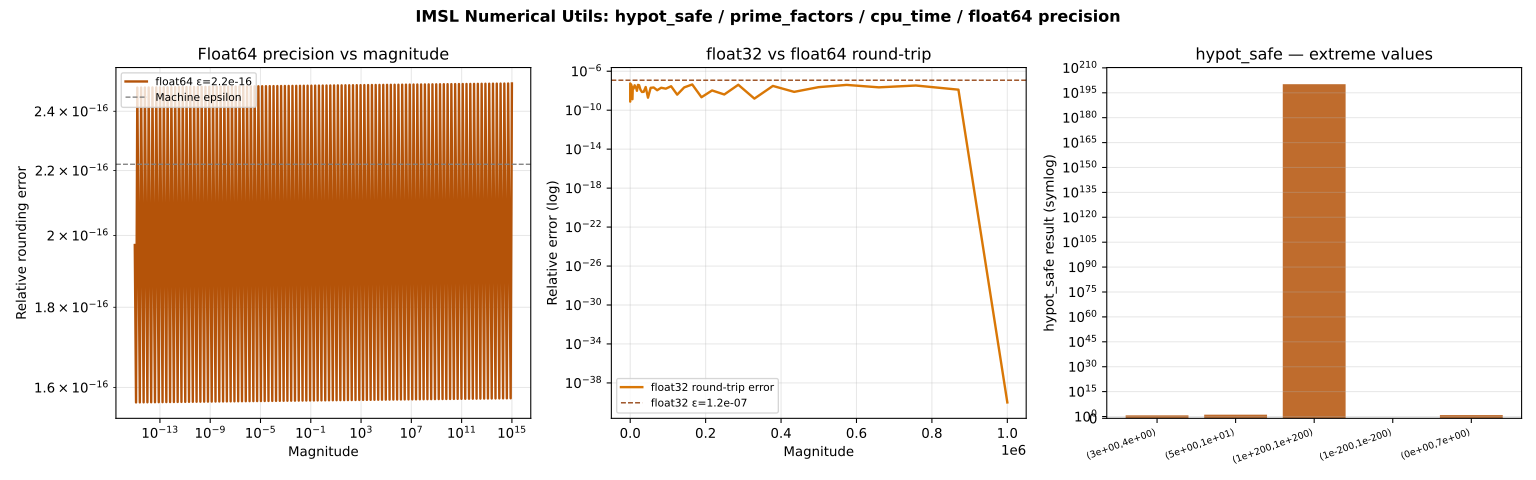
Left: relative rounding error of float64 vs magnitude on a log–log scale.
Centre: float32 round-trip relative error showing ~7 decimal digits of
precision. Right: utilities.hypot_safe() results for extreme
(overflow/underflow) inputs on a symlog y-axis.
Console Output
IMSL Numerical Utilities Example
=======================================================

  Machine Constants (float64 / IEEE 754 double)
  Machine epsilon               2.220446e-16
  Float max                     1.797693e+308
  Float min (tiny)              2.225074e-308
  Mantissa bits                 52
  Decimal digits                15
  Python sys.float_info.epsilon  2.220446e-16

  hypot_safe ΓÇö overflow/underflow-safe hypotenuse
             a             b        hypot_safe   naive ok?
  --------------------------------------------------------
     3.000e+00     4.000e+00      5.000000e+00         yes
     5.000e+00     1.200e+01      1.300000e+01         yes
    1.000e+200    1.000e+200     1.414214e+200    overflow
    1.000e-200    1.000e-200     1.414214e-200         yes
     0.000e+00     7.300e+00      7.300000e+00         yes

  prime_factors ΓÇö integer factorisation
           n  factors
  ----------------------------------------
          12  2 × 2 × 3
          60  2 × 2 × 3 × 5
         100  2 × 2 × 5 × 5
         360  2 × 2 × 2 × 3 × 3 × 5
        1024  2 × 2 × 2 × 2 × 2 × 2 × 2 × 2 × 2 × 2
        9999  3 × 3 × 11 × 101
          97  97
     1000003  1000003

  cpu_time (CPSEC): eig(200×200) took 15.625 ms CPU time

Plot saved to: test_output\example_imsl_numerical_utils.svg