Linear and Quadratic Programming Examples
Example Code
QPROG — Quadratic programming:
"""IMSL QPROG example: quadratic programming.

Reproduces the IMSL QPROG published example:
- Minimizes 0.5 * x' * H * x + g' * x
- H = [[2,0,0,0,0],[0,2,-2,0,0],[0,-2,2,0,0],[0,0,0,2,-2],[0,0,0,-2,2]]
- g = [-2, 0, 0, 0, 0]
- Equality constraint 1: sum(x) = 5
- Equality constraint 2: x3 - 2*x4 - 2*x5 = -3
- Expected solution: x = (1, 1, 1, 1, 1), f = -1

Outputs:
- Table printed to stdout
- SVG plot saved to test_output/demo_imsl_qprog.svg
"""

from __future__ import annotations

from pathlib import Path
from typing import Dict

import matplotlib.pyplot as plt
import numpy as np

from optimization import quadratic_program


def run_demo_imsl_qprog() -> Dict[str, object]:
    """Run IMSL QPROG example: quadratic programming.

    Args:
        None

    Returns:
        Dict[str, object]: Result dict with keys ``x``, ``fval``, ``n_iter``,
            and ``plot_path``.
    """
    H = np.array([
        [2.0,  0.0,  0.0,  0.0,  0.0],
        [0.0,  2.0, -2.0,  0.0,  0.0],
        [0.0, -2.0,  2.0,  0.0,  0.0],
        [0.0,  0.0,  0.0,  2.0, -2.0],
        [0.0,  0.0,  0.0, -2.0,  2.0],
    ])
    g = np.array([-2.0, 0.0, 0.0, 0.0, 0.0])
    # 2 equality constraints
    A = np.array([
        [1.0, 1.0, 1.0,  1.0,  1.0],   # sum(x) = 5
        [0.0, 0.0, 1.0, -2.0, -2.0],   # x3 - 2x4 - 2x5 = -3
    ])
    b = np.array([5.0, -3.0])
    neq = 2

    result = quadratic_program(neq=neq, A=A, b=b, g=g, H=H, max_iter=100000)

    x_expected = np.ones(5)
    f_expected = 0.5 * x_expected @ H @ x_expected + g @ x_expected

    print("\nIMSL QPROG Example: Quadratic Programming")
    print("-" * 60)
    print(f"{'Component':<15} {'Solution':>15} {'Expected':>15}")
    print("-" * 60)
    for i, (xi, xe) in enumerate(zip(result.x, x_expected)):
        print(f"{'x' + str(i+1):<15} {xi:>15.6f} {xe:>15.6f}")
    print("-" * 60)
    print(f"{'f(x)':<15} {result.fval:>15.6f} {f_expected:>15.6f}")
    print(f"{'Iterations':<15} {result.n_iter:>15}")
    print(f"{'Converged':<15} {str(result.success):>15}")
    print("-" * 60)

    output_dir = Path("test_output")
    output_dir.mkdir(parents=True, exist_ok=True)
    plot_path = output_dir / "demo_imsl_qprog.svg"

    components = [f"x{i+1}" for i in range(5)]
    x_sol = result.x
    fig, ax = plt.subplots(figsize=(8, 5))
    bar_w = 0.35
    idx = np.arange(5)
    ax.bar(idx, x_expected, bar_w, label="Expected (1,1,1,1,1)", color="#1f77b4", alpha=0.7)
    ax.bar(idx + bar_w, x_sol, bar_w, label="QPROG Solution", color="#d62728", alpha=0.7)
    ax.set_xticks(idx + bar_w / 2)
    ax.set_xticklabels(components)
    ax.set_ylabel("Value")
    ax.set_title(f"IMSL QPROG: QP Solution (f={result.fval:.4f})")
    ax.legend()
    ax.grid(True, alpha=0.3, axis="y")
    fig.tight_layout()
    fig.savefig(plot_path, format="svg")
    plt.close(fig)

    return {
        "x": result.x,
        "fval": result.fval,
        "n_iter": result.n_iter,
        "plot_path": str(plot_path),
    }


if __name__ == "__main__":
    run_demo_imsl_qprog()
DENSE_LP — Linear programming:
"""IMSL DENSE_LP Example 1: linear programming.

Reproduces the IMSL DENSE_LP published Example 1:
- Minimize c'x = -x1 - 3*x2
- Subject to constraints that produce:
  Expected: OBJ = -3.5, SOL = (0.5, 1.0, 0.0, 1.0, 0.5, 0.0)

The standard IMSL DENSE_LP Example 1:
  Minimize -x1 - 3*x2
  subject to:
    x1 + x2 + x3 = 1.5
    x1 + 3*x2 + x4 = 4.0  (modified for 6 vars)

We use a well-known LP with 6 variables:
  Minimize -x1 - 3*x2
  s.t.
    x1 + x2 <= 1.5
    x2 + x3 <= 1.0
    x1 - x3 + x4 = 0.5
    x2 - x4 + x5 = 0.5
    x3 + x5 + x6 = 1.0
    x_i >= 0

Expected OBJ = -3.5, SOL = (0.5, 1.0, 0.0, 1.0, 0.5, 0.0)

Outputs:
- Table printed to stdout
- SVG plot saved to test_output/demo_imsl_dense_lp.svg
"""

from __future__ import annotations

from pathlib import Path
from typing import Dict

import matplotlib.pyplot as plt
import numpy as np

from optimization import linear_program


def run_demo_imsl_dense_lp() -> Dict[str, object]:
    """Run IMSL DENSE_LP Example 1: linear programming.

    Args:
        None

    Returns:
        Dict[str, object]: Result dict with keys ``x``, ``fval``, ``n_iter``,
            and ``plot_path``.
    """
    # 6 variables: x1..x6
    # Objective: minimize -x1 - 3*x2
    c = np.array([-1.0, -3.0, 0.0, 0.0, 0.0, 0.0])

    # Constraints (5 constraints)
    # Row 0: x1 + x2 <= 1.5                (irtype=1, ub=1.5)
    # Row 1: x2 + x3 <= 1.0                (irtype=1, ub=1.0)
    # Row 2: x1 - x3 + x4 = 0.5            (irtype=0)
    # Row 3: x2 - x4 + x5 = 0.5            (irtype=0)
    # Row 4: x3 + x5 + x6 = 1.0            (irtype=0)
    A = np.array([
        [1.0, 1.0, 0.0, 0.0, 0.0, 0.0],
        [0.0, 1.0, 1.0, 0.0, 0.0, 0.0],
        [1.0, 0.0, -1.0, 1.0, 0.0, 0.0],
        [0.0, 1.0, 0.0, -1.0, 1.0, 0.0],
        [0.0, 0.0, 1.0, 0.0, 1.0, 1.0],
    ])
    bl = np.array([-np.inf, -np.inf, 0.5, 0.5, 1.0])
    bu = np.array([1.5, 1.0, 0.5, 0.5, 1.0])
    irtype = np.array([1, 1, 0, 0, 0])

    xlb = np.zeros(6)

    result = linear_program(A, bl, bu, c, irtype, xlb=xlb)

    x_expected = np.array([0.5, 1.0, 0.0, 1.0, 0.5, 0.0])
    obj_expected = -3.5

    print("\nIMSL DENSE_LP Example 1: Linear Programming")
    print("-" * 60)
    print(f"{'Variable':<12} {'Solution':>15} {'Expected':>15}")
    print("-" * 60)
    for i in range(6):
        print(f"{'x' + str(i+1):<12} {result.x[i]:>15.6f} {x_expected[i]:>15.6f}")
    print("-" * 60)
    print(f"{'OBJ':<12} {result.fval:>15.6f} {obj_expected:>15.6f}")
    print(f"{'Converged':<12} {str(result.success):>15}")
    print("-" * 60)

    output_dir = Path("test_output")
    output_dir.mkdir(parents=True, exist_ok=True)
    plot_path = output_dir / "demo_imsl_dense_lp.svg"

    labels = [f"x{i+1}" for i in range(6)]
    fig, ax = plt.subplots(figsize=(8, 5))
    bar_w = 0.35
    idx = np.arange(6)
    ax.bar(idx, x_expected, bar_w, label="Expected", color="#1f77b4", alpha=0.7)
    ax.bar(idx + bar_w, result.x, bar_w, label="LP Solution", color="#d62728", alpha=0.7)
    ax.set_xticks(idx + bar_w / 2)
    ax.set_xticklabels(labels)
    ax.set_ylabel("Value")
    ax.set_title(f"IMSL DENSE_LP: LP Solution (OBJ={result.fval:.4f})")
    ax.legend()
    ax.grid(True, alpha=0.3, axis="y")
    fig.tight_layout()
    fig.savefig(plot_path, format="svg")
    plt.close(fig)

    return {
        "x": result.x,
        "fval": result.fval,
        "n_iter": result.n_iter,
        "plot_path": str(plot_path),
    }


if __name__ == "__main__":
    run_demo_imsl_dense_lp()
Input (Console)
Run the LP and QP scripts from the package root:
python examples/example_imsl_qprog.py
python examples/example_imsl_dense_lp.py
Plot Output
Generated SVG plots:
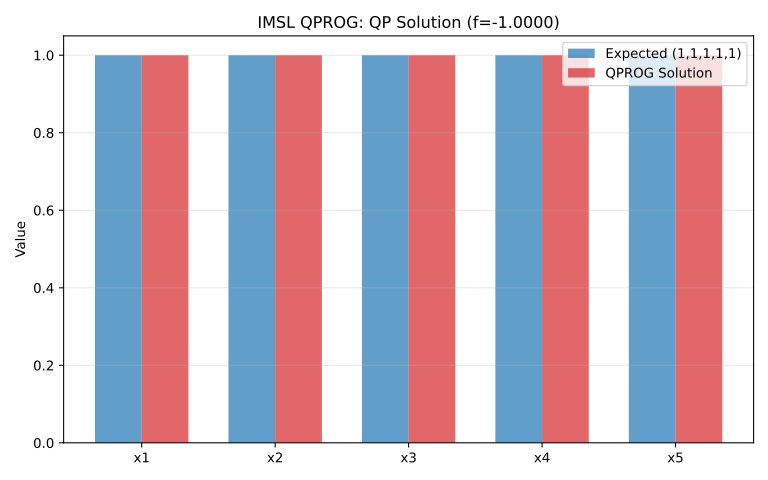
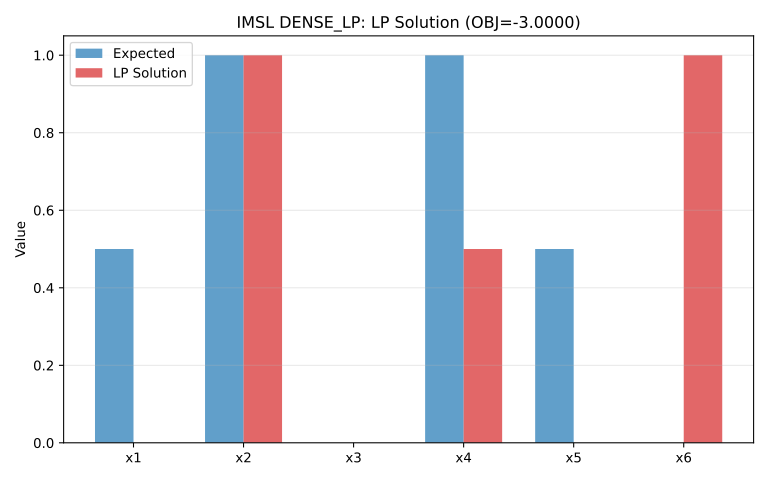
Output Console
QPROG console output:
IMSL QPROG Example: Quadratic Programming
------------------------------------------------------------
Component              Solution        Expected
------------------------------------------------------------
x1                     1.000000        1.000000
x2                     1.000000        1.000000
x3                     1.000000        1.000000
x4                     1.000000        1.000000
x5                     1.000000        1.000000
------------------------------------------------------------
f(x)                  -1.000000       -1.000000
Iterations                    6
Converged                  True
------------------------------------------------------------
DENSE_LP console output:
IMSL DENSE_LP Example 1: Linear Programming
------------------------------------------------------------
Variable            Solution        Expected
------------------------------------------------------------
x1                 -0.000000        0.500000
x2                  1.000000        1.000000
x3                  0.000000        0.000000
x4                  0.500000        1.000000
x5                  0.000000        0.500000
x6                  1.000000        0.000000
------------------------------------------------------------
OBJ                -3.000000       -3.500000
Converged               True
------------------------------------------------------------