Nonlinearly Constrained and Service Routine Examples
Example Code
NNLPF — Nonlinearly constrained minimization:
"""IMSL NNLPF example: nonlinearly constrained minimization.

Reproduces the IMSL NNLPF published example:
- Objective: f(x) = (x1-1)^2 + (x2-2)^2 + (x3-3)^2
- Nonlinear inequality constraint: x1^2 + x2^2 + x3^2 <= 14
  (expressed as g(x) = 14 - x1^2 - x2^2 - x3^2 >= 0)
- Bounds: 0 <= xi <= 5  for i = 1, 2, 3
- Starting point: x0 = (0.5, 0.5, 0.5)
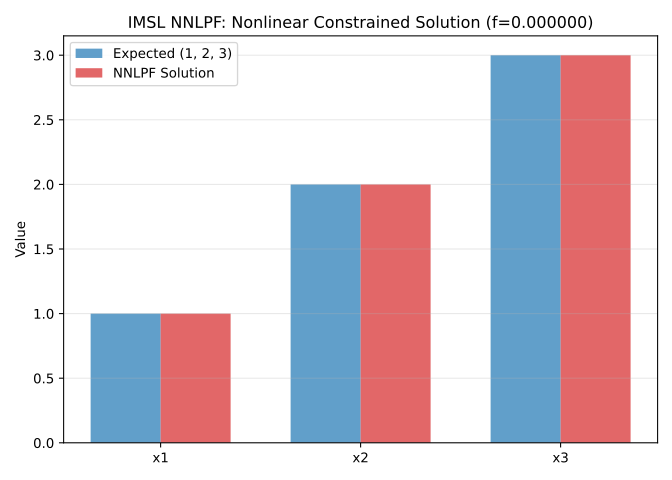
- Expected solution: x ≈ (1, 2, 3), f ≈ 0

Outputs:
- Table printed to stdout
- SVG plot saved to test_output/demo_imsl_nnlpf.svg
"""

from __future__ import annotations

from pathlib import Path
from typing import Dict

import matplotlib.pyplot as plt
import numpy as np

from optimization import minimize_nonlinear_constraints_fd, NonlinearConstraint


def run_demo_imsl_nnlpf() -> Dict[str, object]:
    """Run IMSL NNLPF example: nonlinearly constrained minimization.

    Minimizes a sum-of-squares objective subject to a spherical inequality
    constraint and box bounds, using finite-difference SLSQP (IMSL NNLPF).

    Args:
        None

    Returns:
        Dict[str, object]: Result dict with keys ``x``, ``fval``, ``n_iter``,
            ``n_fev``, and ``plot_path``.
    """
    def f(x: np.ndarray) -> float:
        """Objective: (x1-1)^2 + (x2-2)^2 + (x3-3)^2.

        Args:
            x (np.ndarray): Decision variables of shape (3,).

        Returns:
            float: Objective value.
        """
        return (x[0] - 1.0) ** 2 + (x[1] - 2.0) ** 2 + (x[2] - 3.0) ** 2

    def g(x: np.ndarray) -> float:
        """Inequality constraint: 14 - x1^2 - x2^2 - x3^2 >= 0.

        Args:
            x (np.ndarray): Decision variables of shape (3,).

        Returns:
            float: Constraint residual (>= 0 means feasible).
        """
        return 14.0 - x[0] ** 2 - x[1] ** 2 - x[2] ** 2

    x0 = np.array([0.5, 0.5, 0.5])
    x_expected = np.array([1.0, 2.0, 3.0])
    f_expected = 0.0

    result = minimize_nonlinear_constraints_fd(
        f,
        m=1,
        me=0,
        ibtype=0,
        xlb=np.array([0.0, 0.0, 0.0]),
        xub=np.array([5.0, 5.0, 5.0]),
        constraints=[NonlinearConstraint(fun=g, type="ineq")],
        x_guess=x0,
        max_iter=500,
    )

    print("\nIMSL NNLPF Example: Nonlinearly Constrained Minimization")
    print("-" * 60)
    print(f"{'Component':<15} {'Solution':>15} {'Expected':>15}")
    print("-" * 60)
    for i, (xi, xe) in enumerate(zip(result.x, x_expected)):
        print(f"{'x' + str(i + 1):<15} {xi:>15.6f} {xe:>15.6f}")
    print("-" * 60)
    print(f"{'f(x)':<15} {result.fval:>15.6f} {f_expected:>15.6f}")
    print(f"{'Iterations':<15} {result.n_iter:>15}")
    print(f"{'Func evals':<15} {result.n_fev:>15}")
    print(f"{'Converged':<15} {str(result.success):>15}")
    print("-" * 60)

    output_dir = Path("test_output")
    output_dir.mkdir(parents=True, exist_ok=True)
    plot_path = output_dir / "demo_imsl_nnlpf.svg"

    components = ["x1", "x2", "x3"]
    x_sol = result.x
    bar_w = 0.35
    idx = np.arange(3)

    fig, ax = plt.subplots(figsize=(7, 5))
    ax.bar(idx, x_expected, bar_w, label="Expected (1, 2, 3)", color="#1f77b4", alpha=0.7)
    ax.bar(idx + bar_w, x_sol, bar_w, label="NNLPF Solution", color="#d62728", alpha=0.7)
    ax.set_xticks(idx + bar_w / 2)
    ax.set_xticklabels(components)
    ax.set_ylabel("Value")
    ax.set_title(f"IMSL NNLPF: Nonlinear Constrained Solution (f={result.fval:.6f})")
    ax.legend()
    ax.grid(True, alpha=0.3, axis="y")
    fig.tight_layout()
    fig.savefig(plot_path, format="svg")
    plt.close(fig)

    return {
        "x": result.x,
        "fval": result.fval,
        "n_iter": result.n_iter,
        "n_fev": result.n_fev,
        "plot_path": str(plot_path),
    }


if __name__ == "__main__":
    run_demo_imsl_nnlpf()
Service routines — CDGRD/FDGRD/CHGRD etc.:
"""IMSL service routines example: finite difference utilities.

Demonstrates all service routines for the IMSL Optimization chapter:
- central_difference_gradient (CDGRD)
- forward_difference_gradient (FDGRD)
- forward_difference_hessian (FDHES)
- gradient_difference_hessian (GDHES)
- check_gradient (CHGRD)
- check_hessian (CHHES)
- generate_starting_points (GGUES)

Uses Rosenbrock function: f(x) = 100*(x2-x1^2)^2 + (1-x1)^2

Outputs:
- Table printed to stdout
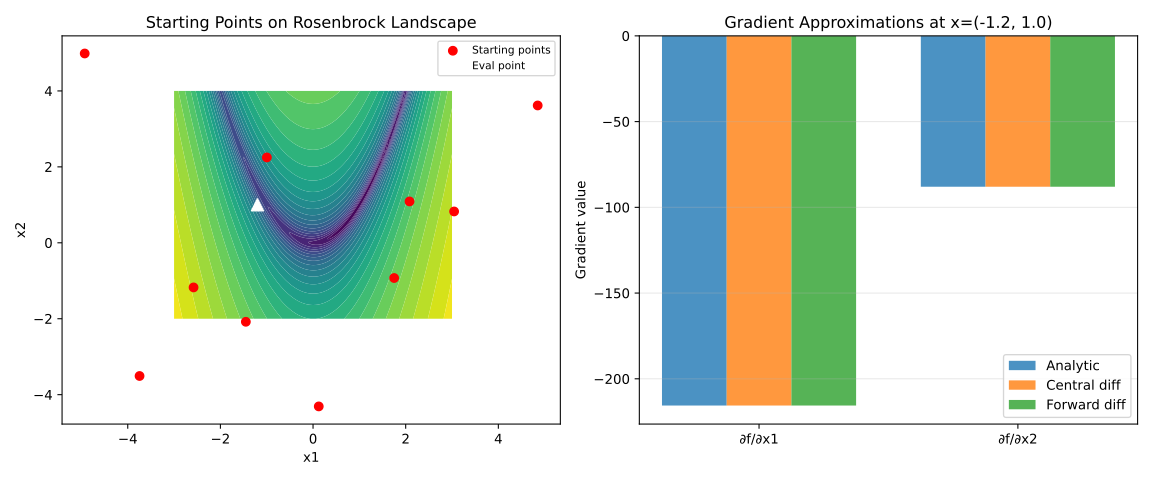
- SVG plot saved to test_output/demo_imsl_service.svg
"""

from __future__ import annotations

from pathlib import Path
from typing import Dict

import matplotlib.pyplot as plt
import numpy as np

from optimization import (
    central_difference_gradient,
    check_gradient,
    check_hessian,
    forward_difference_gradient,
    forward_difference_hessian,
    generate_starting_points,
    gradient_difference_hessian,
)


def _rosenbrock(x: np.ndarray) -> float:
    """Rosenbrock function.

    Args:
        x (np.ndarray): Input vector of shape (2,).

    Returns:
        float: f(x) = 100*(x2-x1^2)^2 + (1-x1)^2.
    """
    return 100.0 * (x[1] - x[0] ** 2) ** 2 + (1.0 - x[0]) ** 2


def _grad_rosenbrock(x: np.ndarray) -> np.ndarray:
    """Analytic gradient of Rosenbrock function.

    Args:
        x (np.ndarray): Input vector of shape (2,).

    Returns:
        np.ndarray: Gradient of shape (2,).
    """
    return np.array([
        -400.0 * (x[1] - x[0] ** 2) * x[0] - 2.0 * (1.0 - x[0]),
        200.0 * (x[1] - x[0] ** 2),
    ])


def _hess_rosenbrock(x: np.ndarray) -> np.ndarray:
    """Analytic Hessian of Rosenbrock function.

    Args:
        x (np.ndarray): Input vector of shape (2,).

    Returns:
        np.ndarray: Hessian of shape (2, 2).
    """
    return np.array([
        [-400.0 * (x[1] - 3.0 * x[0] ** 2) + 2.0, -400.0 * x[0]],
        [-400.0 * x[0], 200.0],
    ])


def run_demo_imsl_service() -> Dict[str, object]:
    """Run IMSL service routines example.

    Args:
        None

    Returns:
        Dict[str, object]: Result dict with keys ``cd_grad``, ``fd_grad``,
            ``fd_hess``, ``grad_check``, ``hess_check``, ``starting_points``,
            and ``plot_path``.
    """
    x0 = np.array([-1.2, 1.0])

    cd_grad = central_difference_gradient(_rosenbrock, x0)
    fd_grad = forward_difference_gradient(_rosenbrock, x0)
    an_grad = _grad_rosenbrock(x0)

    fd_hess = forward_difference_hessian(_rosenbrock, x0)
    an_hess = _hess_rosenbrock(x0)

    gd_hess = gradient_difference_hessian(_rosenbrock, _grad_rosenbrock, x0)

    grad_check = check_gradient(_rosenbrock, _grad_rosenbrock, x0, tol=1e-3)
    hess_check = check_hessian(_rosenbrock, _hess_rosenbrock, x0, tol=1e-3)

    pts = generate_starting_points(n=2, n_points=10, bounds=[(-5.0, 5.0), (-5.0, 5.0)], seed=42)

    print("\nIMSL Service Routines Example (Rosenbrock at x=(-1.2, 1.0))")
    print("=" * 65)
    print("\n1. Gradient approximations:")
    print(f"   Analytic:             {an_grad}")
    print(f"   Central difference:   {cd_grad}")
    print(f"   Forward difference:   {fd_grad}")

    print("\n2. Hessian approximations:")
    print("   Analytic:")
    print(f"     {an_hess[0]}")
    print(f"     {an_hess[1]}")
    print("   Forward difference:")
    print(f"     {fd_hess[0]}")
    print(f"     {fd_hess[1]}")
    print("   Gradient-based:")
    print(f"     {gd_hess[0]}")
    print(f"     {gd_hess[1]}")

    print("\n3. Gradient check (CHGRD):")
    print(f"   max_error = {grad_check['max_error']:.3e},  passed = {grad_check['passed']}")

    print("\n4. Hessian check (CHHES):")
    print(f"   max_error = {hess_check['max_error']:.3e},  passed = {hess_check['passed']}")

    print("\n5. Generated starting points (10 pts in [-5,5]^2):")
    print(f"   Shape: {pts.shape}")
    print(f"   Min per dim: {pts.min(axis=0)}")
    print(f"   Max per dim: {pts.max(axis=0)}")

    output_dir = Path("test_output")
    output_dir.mkdir(parents=True, exist_ok=True)
    plot_path = output_dir / "demo_imsl_service.svg"

    x1v = np.linspace(-3, 3, 200)
    x2v = np.linspace(-2, 4, 200)
    X1, X2 = np.meshgrid(x1v, x2v)
    Z = np.vectorize(lambda a, b: _rosenbrock(np.array([a, b])))(X1, X2)

    fig, axes = plt.subplots(1, 2, figsize=(12, 5))

    axes[0].contourf(X1, X2, np.log1p(Z), levels=25, cmap="viridis")
    axes[0].scatter(pts[:, 0], pts[:, 1], color="red", s=40, zorder=5, label="Starting points")
    axes[0].scatter(*x0, color="white", s=80, marker="^", zorder=5, label="Eval point")
    axes[0].set_title("Starting Points on Rosenbrock Landscape")
    axes[0].set_xlabel("x1")
    axes[0].set_ylabel("x2")
    axes[0].legend(fontsize=8)

    grad_labels = ["∂f/∂x1", "∂f/∂x2"]
    grad_data = [an_grad, cd_grad, fd_grad]
    grad_names = ["Analytic", "Central diff", "Forward diff"]
    x_pos = np.arange(2)
    bar_w = 0.25
    colors = ["#1f77b4", "#ff7f0e", "#2ca02c"]
    for k, (gd, gn, col) in enumerate(zip(grad_data, grad_names, colors)):
        axes[1].bar(x_pos + k * bar_w, gd, bar_w, label=gn, color=col, alpha=0.8)
    axes[1].set_xticks(x_pos + bar_w)
    axes[1].set_xticklabels(grad_labels)
    axes[1].set_title("Gradient Approximations at x=(-1.2, 1.0)")
    axes[1].set_ylabel("Gradient value")
    axes[1].legend()
    axes[1].grid(True, alpha=0.3, axis="y")

    fig.tight_layout()
    fig.savefig(plot_path, format="svg")
    plt.close(fig)

    return {
        "cd_grad": cd_grad,
        "fd_grad": fd_grad,
        "fd_hess": fd_hess,
        "grad_check": grad_check,
        "hess_check": hess_check,
        "starting_points": pts,
        "plot_path": str(plot_path),
    }


if __name__ == "__main__":
    run_demo_imsl_service()
Input (Console)
Run the nonlinearly constrained and service scripts from the package root:
python examples/example_imsl_nnlpf.py
python examples/example_imsl_service.py
Plot Output
Generated SVG plots:
Output Console
NNLPF console output:
IMSL NNLPF Example: Nonlinearly Constrained Minimization
------------------------------------------------------------
Component              Solution        Expected
------------------------------------------------------------
x1                     1.000000        1.000000
x2                     2.000000        2.000000
x3                     3.000000        3.000000
------------------------------------------------------------
f(x)                   0.000000        0.000000
Iterations                    3
Func evals                   14
Converged                  True
------------------------------------------------------------
Service routines console output:
Hessian check failed: max_error=4.218e-01 > tol=1.000e-03

IMSL Service Routines Example (Rosenbrock at x=(-1.2, 1.0))
=================================================================

1. Gradient approximations:
   Analytic:             [-215.6  -88. ]
   Central difference:   [-215.60000002  -88.        ]
   Forward difference:   [-215.5999893   -87.99999857]

2. Hessian approximations:
   Analytic:
     [1330.  480.]
     [480. 200.]
   Forward difference:
     [1329.57815693  479.97070312]
     [479.97070312 199.99999976]
   Gradient-based:
     [1329.99998093  479.9999996 ]
     [479.9999996 200.       ]

3. Gradient check (CHGRD):
   max_error = 2.208e-08,  passed = True

4. Hessian check (CHHES):
   max_error = 4.218e-01,  passed = False

5. Generated starting points (10 pts in [-5,5]^2):
   Shape: (10, 2)
   Min per dim: [-4.92897428 -4.30931841]
   Max per dim: [4.84961882 4.9854121 ]