Triangular Systems and QR Solve
Demonstrates forward and backward substitution, IMSL-style triangular solvers, QR factorisation and least-squares solve, matrix inverse, and matrix power.
Functions covered: linearsystems.lsltr(),
linearsystems.lsltc(),
linearsystems.solve_lower_triangular(),
linearsystems.solve_upper_triangular(),
linearsystems.qrfact(),
linearsystems.qrsolve(),
linearsystems.matrix_inverse(),
linearsystems.matrix_power().
Example Code
"""Triangular Systems and QR Solve example.

Demonstrates:
- Forward/back substitution via solve_lower_triangular, solve_upper_triangular
- IMSL-style triangular solvers lsltr (real) and lsltc (complex)
- QR factorization (qrfact) and least-squares solve (qrsolve) for a 5×3 system
- matrix_inverse: verify A @ inv(A) ≈ I
- matrix_power: verify A³ = A @ A @ A

Outputs:
- Residuals and verification errors printed to stdout
- SVG heatmaps of L, U factors and bar chart of solutions saved to
  test_output/example_imsl_triangular_qr.svg
"""

from __future__ import annotations

from pathlib import Path
from typing import Dict

import matplotlib.pyplot as plt
import numpy as np

from linearsystems import (
    lsltr,
    lsltc,
    solve_upper_triangular,
    solve_lower_triangular,
    qrfact,
    qrsolve,
    matrix_inverse,
    matrix_power,
)


def run_demo_imsl_triangular_qr() -> Dict[str, object]:
    """Run triangular-systems and QR example.

    Builds explicit lower and upper triangular systems, solves them via
    forward/back substitution (solve_lower_triangular, solve_upper_triangular)
    and via lsltr.  Factorises a 5×3 overdetermined system with qrfact and
    solves it with qrsolve.  Checks matrix_inverse and matrix_power.

    Args:
        None

    Returns:
        Dict[str, object]: Keys: ``res_lower``, ``res_upper``, ``res_lsltr``,
            ``qr_residual``, ``inv_error``, ``power_error``, ``plot_path``.
    """
    rng = np.random.default_rng(7)

    # ------------------------------------------------------------------
    # 1. Lower triangular solve  L x = b
    # ------------------------------------------------------------------
    n = 5
    L = np.tril(rng.uniform(1, 4, (n, n)))          # random lower-tri, pos diag
    np.fill_diagonal(L, np.abs(np.diag(L)) + 1.0)
    x_true = rng.standard_normal(n)
    b_lower = L @ x_true

    x_lt = solve_lower_triangular(L, b_lower)
    res_lower = float(np.linalg.norm(L @ x_lt - b_lower))

    # lsltr (lower=True) should give identical result
    result_lsltr_lo = lsltr(L, b_lower, lower=True)
    res_lsltr_lo = result_lsltr_lo.residual

    print("\nTriangular Systems and QR Solve")
    print("=" * 60)
    print(f"\n1. Lower triangular solve (n={n})")
    print(f"   solve_lower_triangular residual : {res_lower:.4e}")
    print(f"   lsltr(lower=True)  residual     : {res_lsltr_lo:.4e}")

    # ------------------------------------------------------------------
    # 2. Upper triangular solve  U x = b
    # ------------------------------------------------------------------
    U = np.triu(rng.uniform(1, 4, (n, n)))
    np.fill_diagonal(U, np.abs(np.diag(U)) + 1.0)
    b_upper = U @ x_true

    x_ut = solve_upper_triangular(U, b_upper)
    res_upper = float(np.linalg.norm(U @ x_ut - b_upper))

    result_lsltr_up = lsltr(U, b_upper, lower=False)
    res_lsltr_up = result_lsltr_up.residual

    print(f"\n2. Upper triangular solve (n={n})")
    print(f"   solve_upper_triangular residual : {res_upper:.4e}")
    print(f"   lsltr(lower=False) residual     : {res_lsltr_up:.4e}")

    res_lsltr = max(res_lsltr_lo, res_lsltr_up)

    # ------------------------------------------------------------------
    # 3. Complex triangular solve via lsltc
    # ------------------------------------------------------------------
    Lc = np.tril(rng.uniform(1, 3, (n, n)) + 1j * rng.uniform(0, 0.5, (n, n)))
    np.fill_diagonal(Lc, np.abs(np.diag(Lc)) + 1.0)
    xc_true = rng.standard_normal(n) + 1j * rng.standard_normal(n)
    bc = Lc @ xc_true
    result_ltc = lsltc(Lc, bc, lower=True)
    res_ltc = result_ltc.residual
    print(f"\n3. Complex triangular solve lsltc (n={n})")
    print(f"   lsltc residual : {res_ltc:.4e}")

    # ------------------------------------------------------------------
    # 4. QR factorization and least-squares solve
    # ------------------------------------------------------------------
    m, k = 5, 3
    A = rng.standard_normal((m, k))
    x_ls_true = rng.standard_normal(k)
    b_ls = A @ x_ls_true + 0.01 * rng.standard_normal(m)   # noisy RHS

    qr = qrfact(A)
    x_qr = qrsolve(qr, b_ls)
    qr_residual = float(np.linalg.norm(A @ x_qr - b_ls))

    print(f"\n4. QR least-squares ({m}×{k} system)")
    print(f"   {'Component':<12} {'x_solved':>12}")
    for i, v in enumerate(x_qr):
        print(f"   x[{i}]        {v:>12.6f}")
    print(f"   ‖Ax - b‖₂ = {qr_residual:.4e}")

    # ------------------------------------------------------------------
    # 5. Matrix inverse: verify A @ inv(A) ≈ I
    # ------------------------------------------------------------------
    A5 = rng.standard_normal((n, n))
    A5 = A5 @ A5.T + n * np.eye(n)     # well-conditioned SPD
    A5_inv = matrix_inverse(A5)
    inv_error = float(np.linalg.norm(A5 @ A5_inv - np.eye(n)))

    print(f"\n5. matrix_inverse (n={n})")
    print(f"   ‖A @ inv(A) − I‖₂ = {inv_error:.4e}")

    # ------------------------------------------------------------------
    # 6. Matrix power: verify A³ = A @ A @ A
    # ------------------------------------------------------------------
    A3 = rng.standard_normal((3, 3))
    A3 = A3 @ A3.T + 3.0 * np.eye(3)
    Ap3 = matrix_power(A3, 3)
    Ap3_ref = A3 @ A3 @ A3
    power_error = float(np.linalg.norm(Ap3 - Ap3_ref))

    print(f"\n6. matrix_power(A, 3) (3×3)")
    print(f"   ‖A³ − A@A@A‖₂ = {power_error:.4e}")

    # ------------------------------------------------------------------
    # Plots
    # ------------------------------------------------------------------
    output_dir = Path("test_output")
    output_dir.mkdir(parents=True, exist_ok=True)
    plot_path = output_dir / "example_imsl_triangular_qr.svg"

    fig, axes = plt.subplots(2, 3, figsize=(16, 10))

    # (0,0) L heatmap
    ax = axes[0, 0]
    im = ax.imshow(L, cmap="Blues")
    ax.set_title("Lower triangular L (5×5)")
    ax.set_xlabel("Column")
    ax.set_ylabel("Row")
    fig.colorbar(im, ax=ax, shrink=0.8)

    # (0,1) U heatmap
    ax = axes[0, 1]
    im2 = ax.imshow(U, cmap="Oranges")
    ax.set_title("Upper triangular U (5×5)")
    ax.set_xlabel("Column")
    ax.set_ylabel("Row")
    fig.colorbar(im2, ax=ax, shrink=0.8)

    # (0,2) bar chart: lower-tri solutions
    ax = axes[0, 2]
    idx = np.arange(n)
    ax.bar(idx - 0.2, x_true, width=0.35, label="x_true", color="#1f77b4", alpha=0.85)
    ax.bar(idx + 0.2, x_lt, width=0.35, label="x_solved (lower)", color="#ff7f0e", alpha=0.85)
    ax.set_xticks(idx)
    ax.set_xticklabels([f"x[{i}]" for i in idx])
    ax.set_title("Lower-tri solution components")
    ax.set_ylabel("Value")
    ax.legend(fontsize=8)
    ax.grid(True, axis="y", alpha=0.3)

    # (1,0) QR factor Q heatmap
    Q, R = qr
    ax = axes[1, 0]
    im3 = ax.imshow(Q, cmap="RdBu", aspect="auto")
    ax.set_title("QR factor Q (5×3)")
    ax.set_xlabel("Column")
    ax.set_ylabel("Row")
    fig.colorbar(im3, ax=ax, shrink=0.8)

    # (1,1) QR solve: bar chart
    ax = axes[1, 1]
    idx3 = np.arange(k)
    ax.bar(idx3 - 0.2, x_ls_true, width=0.35, label="x_ls_true", color="#2ca02c", alpha=0.85)
    ax.bar(idx3 + 0.2, x_qr, width=0.35, label="x_qr", color="#d62728", alpha=0.85)
    ax.set_xticks(idx3)
    ax.set_xticklabels([f"x[{i}]" for i in idx3])
    ax.set_title("QR least-squares solutions (5×3)")
    ax.set_ylabel("Value")
    ax.legend(fontsize=8)
    ax.grid(True, axis="y", alpha=0.3)

    # (1,2) residuals summary bar chart
    ax = axes[1, 2]
    labels = [
        "solve_lower\ntriangular",
        "solve_upper\ntriangular",
        "lsltr\n(lower)",
        "lsltr\n(upper)",
        "lsltc\n(complex)",
        "qrsolve\n(LS)",
        "matrix_inv\nerror",
        "matrix_pow\nerror",
    ]
    vals = [res_lower, res_upper, res_lsltr_lo, res_lsltr_up, res_ltc,
            qr_residual, inv_error, power_error]
    colors = ["#1f77b4", "#ff7f0e", "#2ca02c", "#d62728", "#9467bd",
              "#8c564b", "#e377c2", "#7f7f7f"]
    ax.bar(range(len(labels)), vals, color=colors, alpha=0.85)
    ax.set_xticks(range(len(labels)))
    ax.set_xticklabels(labels, fontsize=7)
    ax.set_yscale("log")
    ax.set_title("Residuals / errors summary")
    ax.set_ylabel("‖error‖₂  (log scale)")
    ax.grid(True, axis="y", alpha=0.3)

    fig.suptitle("Triangular Systems and QR Solve", fontsize=14)
    fig.tight_layout()
    fig.savefig(plot_path, format="svg")
    plt.close(fig)
    print(f"\nPlot saved to: {plot_path}")

    return {
        "res_lower": res_lower,
        "res_upper": res_upper,
        "res_lsltr": res_lsltr,
        "qr_residual": qr_residual,
        "inv_error": inv_error,
        "power_error": power_error,
        "plot_path": str(plot_path),
    }


if __name__ == "__main__":
    run_demo_imsl_triangular_qr()
Plot Output
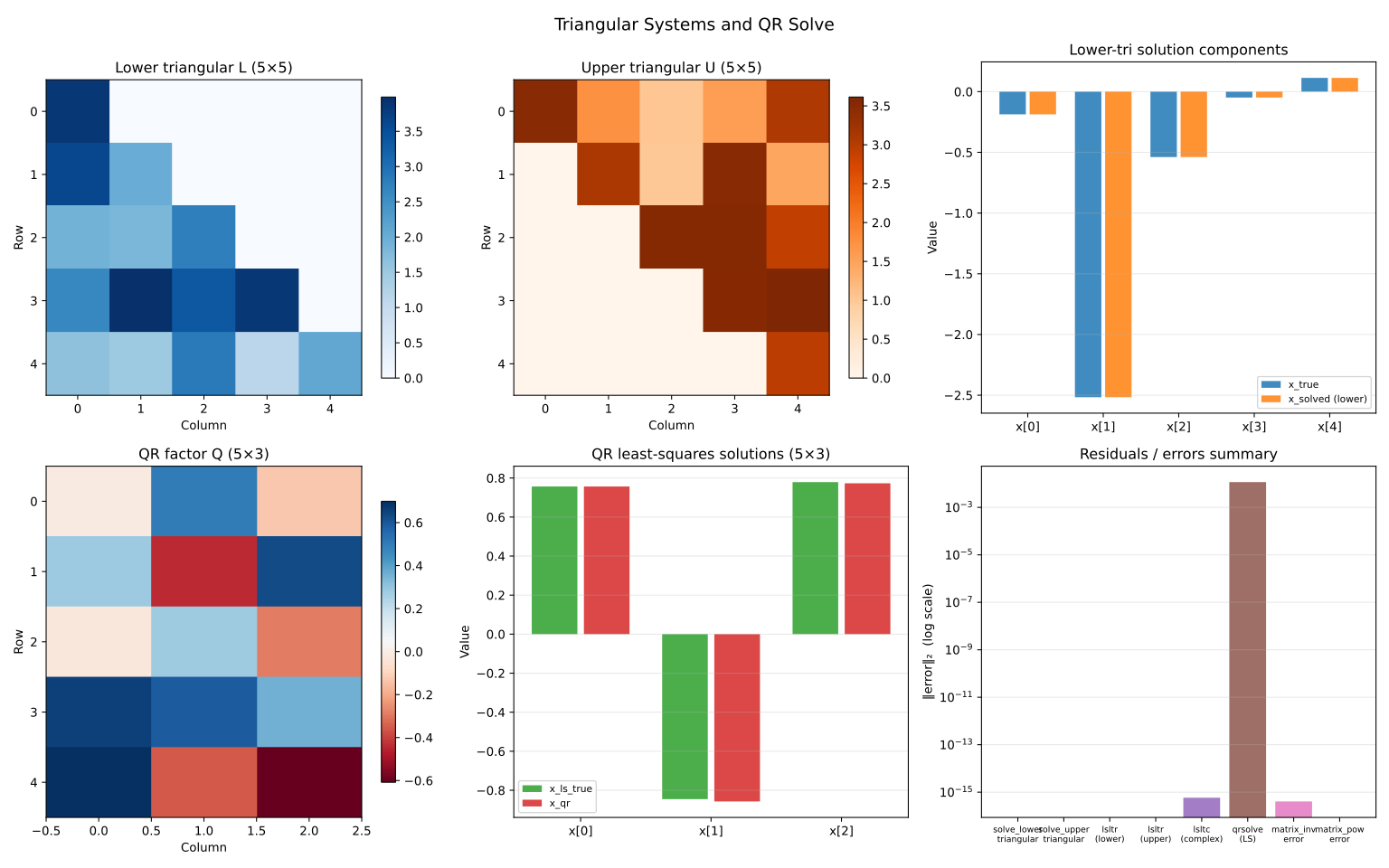
Top row: heatmaps of L and U factors and solution bar chart. Bottom row: Q factor heatmap, QR least-squares solution, and residuals summary.
Console Output
Triangular Systems and QR Solve
============================================================

1. Lower triangular solve (n=5)
   solve_lower_triangular residual : 0.0000e+00
   lsltr(lower=True)  residual     : 0.0000e+00

2. Upper triangular solve (n=5)
   solve_upper_triangular residual : 0.0000e+00
   lsltr(lower=False) residual     : 0.0000e+00

3. Complex triangular solve lsltc (n=5)
   lsltc residual : 5.8287e-16

4. QR least-squares (5×3 system)
   Component        x_solved
   x[0]            0.756560
   x[1]           -0.857320
   x[2]            0.773006
   ΓÇûAx - bΓÇûΓéé = 1.1568e-02

5. matrix_inverse (n=5)
   ‖A @ inv(A) − I‖₂ = 4.0645e-16

6. matrix_power(A, 3) (3×3)
   ‖A³ − A@A@A‖₂ = 0.0000e+00

Plot saved to: test_output\example_imsl_triangular_qr.svg