Matrix Norms and Conditioning
Demonstrates vector norms, matrix norms, condition number growth for Hilbert matrices, reciprocal condition number estimation, and the Moore-Penrose pseudo-inverse.
Functions covered: linearsystems.vector_norm(),
linearsystems.matrix_norm(),
linearsystems.condition_number(),
linearsystems.rcond_estimate(),
linearsystems.pseudo_inverse().
Example Code
"""Matrix Norms and Conditioning example.

Demonstrates:
- vector_norm: compute 1-, 2-, and inf-norms of several vectors
- matrix_norm: compute 1-, 2- (spectral), inf-, and Frobenius norms
- condition_number: show ill-conditioning of Hilbert matrices (sizes 2..8)
- rcond_estimate: compare with 1/condition_number
- pseudo_inverse: Moore-Penrose pseudo-inverse of a rank-deficient matrix,
  verify all four Moore-Penrose conditions

Outputs:
- All norms and condition numbers printed to stdout
- SVG plot: condition number vs matrix size (log scale) + norm bar charts
  saved to test_output/example_imsl_norms_conditioning.svg
"""

from __future__ import annotations

from pathlib import Path
from typing import Dict

import matplotlib.pyplot as plt
import numpy as np

from linearsystems import (
    vector_norm,
    matrix_norm,
    condition_number,
    rcond_estimate,
    pseudo_inverse,
)


def _hilbert(n: int) -> np.ndarray:
    """Return the n×n Hilbert matrix H[i,j] = 1/(i+j+1).

    Args:
        n (int): Size of the Hilbert matrix.

    Returns:
        np.ndarray: Hilbert matrix of shape (n, n).
    """
    i, j = np.meshgrid(np.arange(n), np.arange(n), indexing="ij")
    return 1.0 / (i + j + 1)


def run_demo_imsl_norms_conditioning() -> Dict[str, object]:
    """Run matrix norms and conditioning demo.

    Exercises vector_norm, matrix_norm, condition_number, rcond_estimate,
    and pseudo_inverse.  Reports all computed values and verifies the four
    Moore-Penrose conditions for the pseudo-inverse.

    Args:
        None

    Returns:
        Dict[str, object]: Keys: ``cond_numbers`` (list), ``rcond_estimates``
            (list), ``mp_errors`` (list of 4 floats), ``plot_path`` (str).
    """
    rng = np.random.default_rng(13)

    # ------------------------------------------------------------------
    # 1. Vector norms
    # ------------------------------------------------------------------
    vectors = {
        "v1 = [1,2,3,4,5]": np.array([1.0, 2, 3, 4, 5]),
        "v2 = ones(8)": np.ones(8),
        "v3 = randn(6)": rng.standard_normal(6),
    }

    print("\nMatrix Norms and Conditioning")
    print("=" * 70)
    print("\n1. Vector norms")
    print(f"  {'Vector':<22} {'1-norm':>10} {'2-norm':>10} {'inf-norm':>10}")
    print("  " + "-" * 55)
    for name, v in vectors.items():
        n1 = vector_norm(v, ord=1)
        n2 = vector_norm(v, ord=2)
        ni = vector_norm(v, ord=np.inf)
        print(f"  {name:<22} {n1:>10.4f} {n2:>10.4f} {ni:>10.4f}")

    # ------------------------------------------------------------------
    # 2. Matrix norms
    # ------------------------------------------------------------------
    matrices = {
        "A (3×3 random)": rng.standard_normal((3, 3)),
        "I (5×5)": np.eye(5),
        "Hilbert(4)": _hilbert(4),
    }

    print("\n2. Matrix norms")
    print(
        f"  {'Matrix':<18} {'1-norm':>10} {'spectral':>10}"
        f" {'inf-norm':>10} {'Frobenius':>10}"
    )
    print("  " + "-" * 62)
    for name, M in matrices.items():
        mn1 = matrix_norm(M, ord=1)
        mn2 = matrix_norm(M, ord=2)
        mni = matrix_norm(M, ord=np.inf)
        mnf = matrix_norm(M, ord="fro")
        print(f"  {name:<18} {mn1:>10.4f} {mn2:>10.4f} {mni:>10.4f} {mnf:>10.4f}")

    # ------------------------------------------------------------------
    # 3. Condition numbers of Hilbert matrices
    # ------------------------------------------------------------------
    sizes = list(range(2, 9))
    cond_numbers = []
    rcond_estimates = []

    print("\n3. Condition numbers of Hilbert matrices")
    print(f"  {'n':>4} {'cond(H)':>18} {'rcond_est':>14} {'1/cond':>14} {'match?':>8}")
    print("  " + "-" * 65)
    for n in sizes:
        H = _hilbert(n)
        c = condition_number(H)
        rc = rcond_estimate(H)
        ref_rc = 1.0 / c if c > 0 else 0.0
        match = "yes" if abs(rc - ref_rc) / (ref_rc + 1e-300) < 0.01 else "~"
        print(f"  {n:>4} {c:>18.4e} {rc:>14.4e} {ref_rc:>14.4e} {match:>8}")
        cond_numbers.append(c)
        rcond_estimates.append(rc)

    # ------------------------------------------------------------------
    # 4. Pseudo-inverse of a rank-deficient matrix
    # ------------------------------------------------------------------
    # Build a 4×3 rank-2 matrix: rank-deficient
    U2 = rng.standard_normal((4, 2))
    V2 = rng.standard_normal((2, 3))
    A_rd = U2 @ V2          # rank ≤ 2

    A_pinv = pseudo_inverse(A_rd)
    # Moore-Penrose conditions:
    # 1. A @ pinv(A) @ A = A
    mp1 = float(np.linalg.norm(A_rd @ A_pinv @ A_rd - A_rd))
    # 2. pinv(A) @ A @ pinv(A) = pinv(A)
    mp2 = float(np.linalg.norm(A_pinv @ A_rd @ A_pinv - A_pinv))
    # 3. (A @ pinv(A)).T = A @ pinv(A)
    P = A_rd @ A_pinv
    mp3 = float(np.linalg.norm(P - P.T))
    # 4. (pinv(A) @ A).T = pinv(A) @ A
    Q = A_pinv @ A_rd
    mp4 = float(np.linalg.norm(Q - Q.T))
    mp_errors = [mp1, mp2, mp3, mp4]

    print("\n4. Pseudo-inverse of rank-deficient 4×3 matrix (rank ≤ 2)")
    print(f"   A shape: {A_rd.shape},  pinv(A) shape: {A_pinv.shape}")
    print(f"   MP cond 1: ‖A pinv(A) A − A‖    = {mp1:.4e}")
    print(f"   MP cond 2: ‖pinv(A) A pinv(A)−pinv(A)‖ = {mp2:.4e}")
    print(f"   MP cond 3: ‖(A pinv(A))ᵀ − A pinv(A)‖ = {mp3:.4e}")
    print(f"   MP cond 4: ‖(pinv(A) A)ᵀ − pinv(A) A‖ = {mp4:.4e}")

    # ------------------------------------------------------------------
    # Plots
    # ------------------------------------------------------------------
    output_dir = Path("test_output")
    output_dir.mkdir(parents=True, exist_ok=True)
    plot_path = output_dir / "example_imsl_norms_conditioning.svg"

    fig, axes = plt.subplots(1, 3, figsize=(18, 6))

    # (0) Condition number vs Hilbert matrix size
    ax = axes[0]
    ax.semilogy(sizes, cond_numbers, "b-o", linewidth=2, label="cond(H_n)")
    ax.semilogy(sizes, [1.0 / r if r > 0 else np.nan for r in rcond_estimates],
                "r--s", linewidth=1.5, label="1/rcond_est")
    ax.set_xlabel("Matrix size n")
    ax.set_ylabel("Condition number (log scale)")
    ax.set_title("Condition number of Hilbert matrix H_n")
    ax.legend()
    ax.grid(True, alpha=0.3)

    # (1) Vector norms bar chart
    ax2 = axes[1]
    vnames = list(vectors.keys())
    x = np.arange(len(vnames))
    n1s = [vector_norm(v, 1) for v in vectors.values()]
    n2s = [vector_norm(v, 2) for v in vectors.values()]
    nis = [vector_norm(v, np.inf) for v in vectors.values()]
    w = 0.25
    ax2.bar(x - w, n1s, w, label="1-norm", color="#1f77b4", alpha=0.85)
    ax2.bar(x,     n2s, w, label="2-norm", color="#ff7f0e", alpha=0.85)
    ax2.bar(x + w, nis, w, label="inf-norm", color="#2ca02c", alpha=0.85)
    ax2.set_xticks(x)
    ax2.set_xticklabels([f"v{i+1}" for i in range(len(vnames))], fontsize=10)
    ax2.set_title("Vector norms")
    ax2.set_ylabel("Norm value")
    ax2.legend()
    ax2.grid(True, axis="y", alpha=0.3)

    # (2) Moore-Penrose condition errors
    ax3 = axes[2]
    mp_labels = ["MP1\nA pinv A = A", "MP2\npinv A pinv=pinv",
                 "MP3\n(A pinv)ᵀ=A pinv", "MP4\n(pinv A)ᵀ=pinv A"]
    bar_colors = ["#1f77b4", "#ff7f0e", "#2ca02c", "#d62728"]
    bars = ax3.bar(range(4), [max(e, 1e-18) for e in mp_errors],
                   color=bar_colors, alpha=0.85)
    ax3.set_xticks(range(4))
    ax3.set_xticklabels(mp_labels, fontsize=8)
    ax3.set_yscale("log")
    ax3.set_title("Moore-Penrose conditions (pseudo-inverse)")
    ax3.set_ylabel("‖error‖₂  (log scale)")
    ax3.grid(True, axis="y", alpha=0.3)
    for bar, val in zip(bars, mp_errors):
        ax3.text(bar.get_x() + bar.get_width() / 2, bar.get_height() * 1.5,
                 f"{val:.1e}", ha="center", va="bottom", fontsize=7)

    fig.suptitle("Matrix Norms and Conditioning", fontsize=14)
    fig.tight_layout()
    fig.savefig(plot_path, format="svg")
    plt.close(fig)
    print(f"\nPlot saved to: {plot_path}")

    return {
        "cond_numbers": cond_numbers,
        "rcond_estimates": rcond_estimates,
        "mp_errors": mp_errors,
        "plot_path": str(plot_path),
    }


if __name__ == "__main__":
    run_demo_imsl_norms_conditioning()
Plot Output
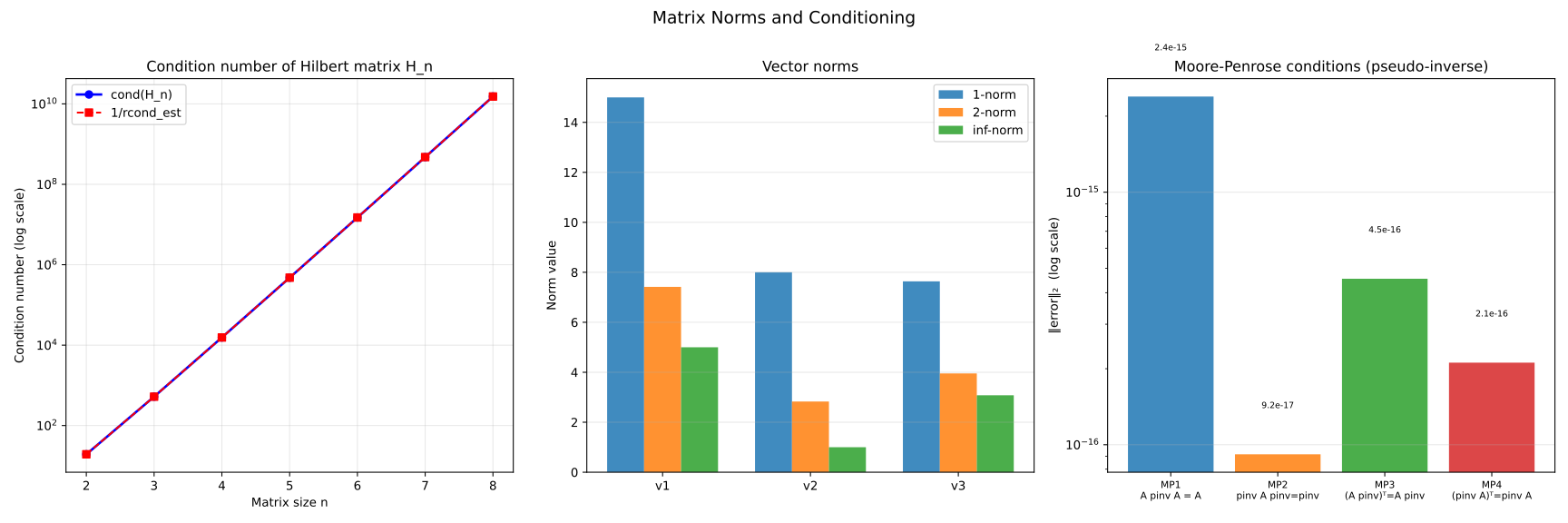
Left: condition number of Hilbert matrices vs size (log scale). Centre: vector 1-, 2-, and inf-norms for three vectors. Right: Moore-Penrose condition errors for the pseudo-inverse.
Console Output
Matrix Norms and Conditioning
======================================================================

1. Vector norms
  Vector                     1-norm     2-norm   inf-norm
  -------------------------------------------------------
  v1 = [1,2,3,4,5]          15.0000     7.4162     5.0000
  v2 = ones(8)               8.0000     2.8284     1.0000
  v3 = randn(6)              7.6367     3.9525     3.0783

2. Matrix norms
  Matrix                 1-norm   spectral   inf-norm  Frobenius
  --------------------------------------------------------------
  A (3×3 random)         2.6550     2.0635     2.3752     2.3092
  I (5×5)                1.0000     1.0000     1.0000     2.2361
  Hilbert(4)             2.0833     1.5002     2.0833     1.5097

3. Condition numbers of Hilbert matrices
     n            cond(H)      rcond_est         1/cond   match?
  -----------------------------------------------------------------
     2         1.9281e+01     5.1863e-02     5.1863e-02      yes
     3         5.2406e+02     1.9082e-03     1.9082e-03      yes
     4         1.5514e+04     6.4459e-05     6.4459e-05      yes
     5         4.7661e+05     2.0982e-06     2.0982e-06      yes
     6         1.4951e+07     6.6885e-08     6.6885e-08      yes
     7         4.7537e+08     2.1036e-09     2.1036e-09      yes
     8         1.5258e+10     6.5541e-11     6.5541e-11      yes

4. Pseudo-inverse of rank-deficient 4×3 matrix (rank ≤ 2)
   A shape: (4, 3),  pinv(A) shape: (3, 4)
   MP cond 1: ‖A pinv(A) A − A‖    = 2.3917e-15
   MP cond 2: ‖pinv(A) A pinv(A)−pinv(A)‖ = 9.1632e-17
   MP cond 3: ‖(A pinv(A))ᵀ − A pinv(A)‖ = 4.5419e-16
   MP cond 4: ‖(pinv(A) A)ᵀ − pinv(A) A‖ = 2.1138e-16

Plot saved to: test_output\example_imsl_norms_conditioning.svg