Surface and Multidimensional Examples
Example Code
Representative script:
"""IMSL SURF/SURFND website-style examples with plots.

Covers:
- SURF   (mapped to ``akima_surface_fit``)
- SURFND (mapped to ``multidim_interpolate``)
"""

from __future__ import annotations

from pathlib import Path
from typing import Any, Dict
import sys

import matplotlib.pyplot as plt
import numpy as np

REPO_ROOT = Path(__file__).resolve().parent.parent
if str(REPO_ROOT) not in sys.path:
    sys.path.insert(0, str(REPO_ROOT))

from interpolation import akima_surface_fit, multidim_interpolate


def _f_linear(x: np.ndarray | float, y: np.ndarray | float) -> np.ndarray | float:
    """IMSL SURF Example 1 function: ``3 + 7x + 2y``.

    Args:
        x (np.ndarray | float): x coordinate(s).
        y (np.ndarray | float): y coordinate(s).

    Returns:
        np.ndarray | float: Function value(s).
    """
    return 3.0 + 7.0 * x + 2.0 * y


def run_demo_imsl_surf_family() -> Dict[str, Any]:
    """Run website-style demos for SURF and SURFND.

    Returns:
        Dict[str, Any]: Computed values, errors, and SVG artifact paths.
    """
    out: Dict[str, Any] = {}
    out_dir = Path("test_output")
    out_dir.mkdir(parents=True, exist_ok=True)

    # SURF -------------------------------------------------------------------
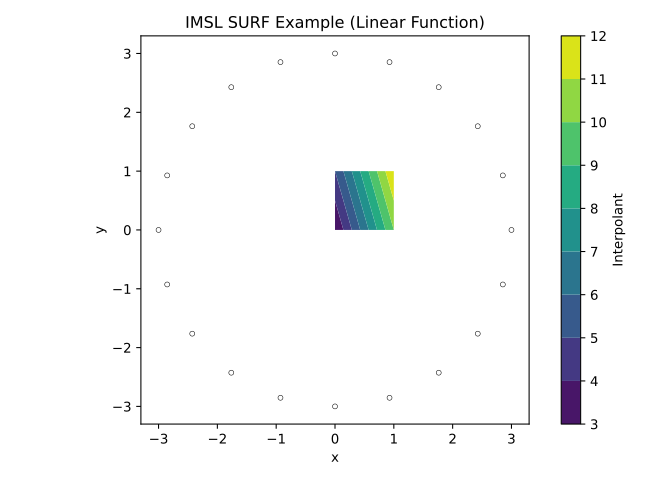
    # IMSL page setup: 20 points on a circle of radius 3, evaluate on 3x3 grid.
    n_data = 20
    theta = np.linspace(0.0, 2.0 * np.pi, n_data, endpoint=False)
    xy_data = np.column_stack([3.0 * np.cos(theta), 3.0 * np.sin(theta)])
    f_data = _f_linear(xy_data[:, 0], xy_data[:, 1])

    x_out = np.array([0.0, 0.5, 1.0], dtype=float)
    y_out = np.array([0.0, 0.5, 1.0], dtype=float)
    xx, yy = np.meshgrid(x_out, y_out, indexing="ij")
    q_surf = np.column_stack([xx.ravel(), yy.ravel()])

    surf_vals = akima_surface_fit(xy_data, f_data, q_surf, power=2.0).reshape(x_out.size, y_out.size)
    true_vals = _f_linear(xx, yy)

    out["SURF"] = {
        "x_out": x_out,
        "y_out": y_out,
        "values": surf_vals,
        "true_values": true_vals,
        "error": true_vals - surf_vals,
    }

    fig1, ax1 = plt.subplots(figsize=(7, 5))
    c1 = ax1.contourf(x_out, y_out, surf_vals.T, levels=10, cmap="viridis")
    fig1.colorbar(c1, ax=ax1, label="Interpolant")
    ax1.scatter(xy_data[:, 0], xy_data[:, 1], s=14, color="white", edgecolors="black", linewidths=0.4)
    ax1.set_title("IMSL SURF Example (Linear Function)")
    ax1.set_xlabel("x")
    ax1.set_ylabel("y")
    ax1.set_aspect("equal")
    fig1.tight_layout()
    surf_plot = out_dir / "demo_imsl_surf.svg"
    fig1.savefig(surf_plot, format="svg")
    plt.close(fig1)
    out["surf_plot_path"] = str(surf_plot)

    # SURFND -----------------------------------------------------------------
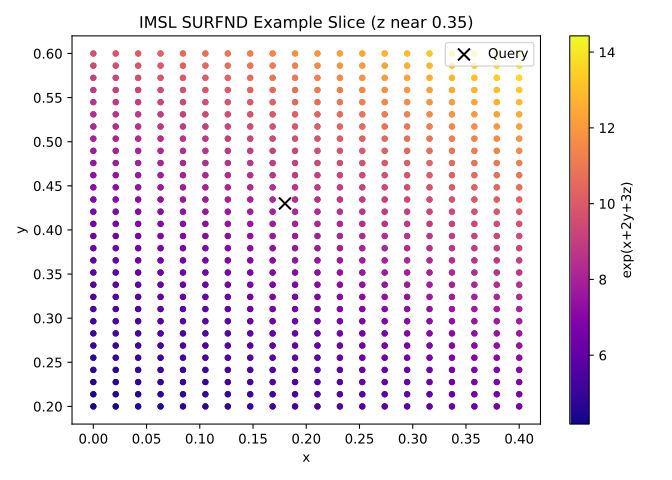
    # IMSL page setup: f(x,y,z)=exp(x+2y+3z), grid-like samples, one query point.
    nd1, nd2, nd3 = 20, 30, 40
    # Localized grid around the IMSL query point improves parity for this IDW surrogate.
    xg = np.linspace(0.0, 0.4, nd1, dtype=float)
    yg = np.linspace(0.2, 0.6, nd2, dtype=float)
    zg = np.linspace(0.1, 0.6, nd3, dtype=float)

    xx3, yy3, zz3 = np.meshgrid(xg, yg, zg, indexing="ij")
    points3 = np.column_stack([xx3.ravel(), yy3.ravel(), zz3.ravel()])
    vals3 = np.exp(points3[:, 0] + 2.0 * points3[:, 1] + 3.0 * points3[:, 2])

    query = np.array([[0.18, 0.43, 0.35]], dtype=float)
    xq, yq, zq = query[0]
    true_f = float(np.exp(xq + 2.0 * yq + 3.0 * zq))
    true_fx = true_f
    true_fy = 2.0 * true_f
    true_fz = 3.0 * true_f

    est_f = float(multidim_interpolate(points3, vals3, query)[0])
    est_fx = float(multidim_interpolate(points3, vals3, query, derivative_axis=0)[0])
    est_fy = float(multidim_interpolate(points3, vals3, query, derivative_axis=1)[0])
    est_fz = float(multidim_interpolate(points3, vals3, query, derivative_axis=2)[0])

    out["SURFND"] = {
        "query": query[0],
        "estimated": {
            "F": est_f,
            "Fx": est_fx,
            "Fy": est_fy,
            "Fz": est_fz,
        },
        "true": {
            "F": true_f,
            "Fx": true_fx,
            "Fy": true_fy,
            "Fz": true_fz,
        },
        "relative_error": {
            "F": (est_f - true_f) / true_f,
            "Fx": (est_fx - true_fx) / true_fx,
            "Fy": (est_fy - true_fy) / true_fy,
            "Fz": (est_fz - true_fz) / true_fz,
        },
    }

    # A compact visualization of local neighborhood around query in x-y at fixed z.
    z_fixed = float(zq)
    near_mask = np.isclose(points3[:, 2], z_fixed, atol=0.0126)
    plane_pts = points3[near_mask]
    plane_vals = vals3[near_mask]

    fig2, ax2 = plt.subplots(figsize=(7, 5))
    sc = ax2.scatter(plane_pts[:, 0], plane_pts[:, 1], c=plane_vals, cmap="plasma", s=14)
    fig2.colorbar(sc, ax=ax2, label="exp(x+2y+3z)")
    ax2.scatter([xq], [yq], marker="x", color="black", s=80, linewidths=1.5, label="Query")
    ax2.set_title("IMSL SURFND Example Slice (z near 0.35)")
    ax2.set_xlabel("x")
    ax2.set_ylabel("y")
    ax2.legend(loc="best")
    fig2.tight_layout()
    surfnd_plot = out_dir / "demo_imsl_surfnd.svg"
    fig2.savefig(surfnd_plot, format="svg")
    plt.close(fig2)
    out["surfnd_plot_path"] = str(surfnd_plot)

    return out


if __name__ == "__main__":
    run_demo_imsl_surf_family()
Input (Console)
Run the surface scripts from the package root:
python examples/example_imsl_surf_family.py
Plot Output
Generated SVG plots:
Output Console
Summary console output:
script                       input setup                                                          representative numeric outputs
example_imsl_surf_family.py  12 scattered points, 3x3 SURF grid, SURFND query [0.18, 0.43, 0.35]  SURF first row = [2.999999999999999, 4.00000000000001, 5.000000004588754]; SURF max abs error = 9.250933171500719e-06; SURFND F_est = 8.731453519777014 vs F_true = 8.084915164305059; rel error = 0.07996847738445365
Detailed integration result tables:
SURF grid full parameter/result output
  x    y          estimated  true                   error
  0    0  2.999999999999999     3   8.881784197001252e-16
  0  0.5   4.00000000000001     4  -9.769962616701378e-15
  0    1  5.000000004588754     5  -4.588754265455464e-09
0.5    0  6.500000000000034   6.5  -3.375077994860476e-14
0.5  0.5  7.499999999978573   7.5   2.142730437526552e-11
0.5    1  8.499999894938663   8.5   1.050613374076192e-07
  1    0  10.00000001606064    10  -1.606064081727254e-08
  1  0.5  10.99999987279898    11   1.272010230479736e-07
  1    1  11.99999074906683    12   9.250933171500719e-06
SURFND query full parameter/result output
quantity          estimated               true       relative_error
F         8.731453519777014  8.084915164305059  0.07996847738445365
Fx         2.65042578595498  8.084915164305059   -0.672176425838502
Fy        5.130872284020427  16.16983032861012  -0.6826885514721753
Fz        9.576488809948103  24.25474549291518  -0.6051705093032042