Constraint Examples
Example Code
Representative script:
"""IMSL CONFT example 1: Monotone constrained B-spline fit.

Reproduces Example 1 from the IMSL CONFT documentation:
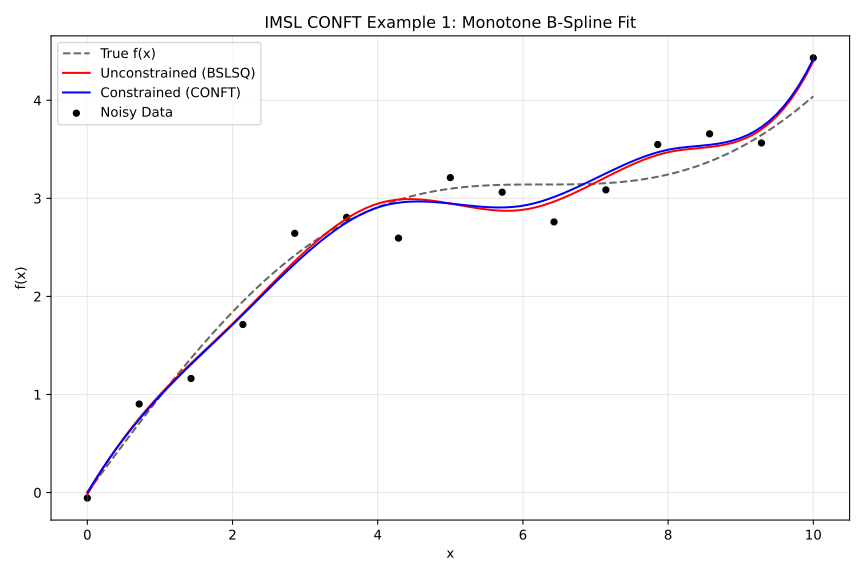
- Function: f(x) = 0.5*x + sin(0.5*x)
- Data: 15 points with random noise in [0, 10]
- Unconstrained fit (BSLSQ) vs Monotone constrained fit (CONFT)
- Constraint: f'(x) >= 0 at 15 points

Outputs:
- Average error comparison (BSLSQ vs CONFT)
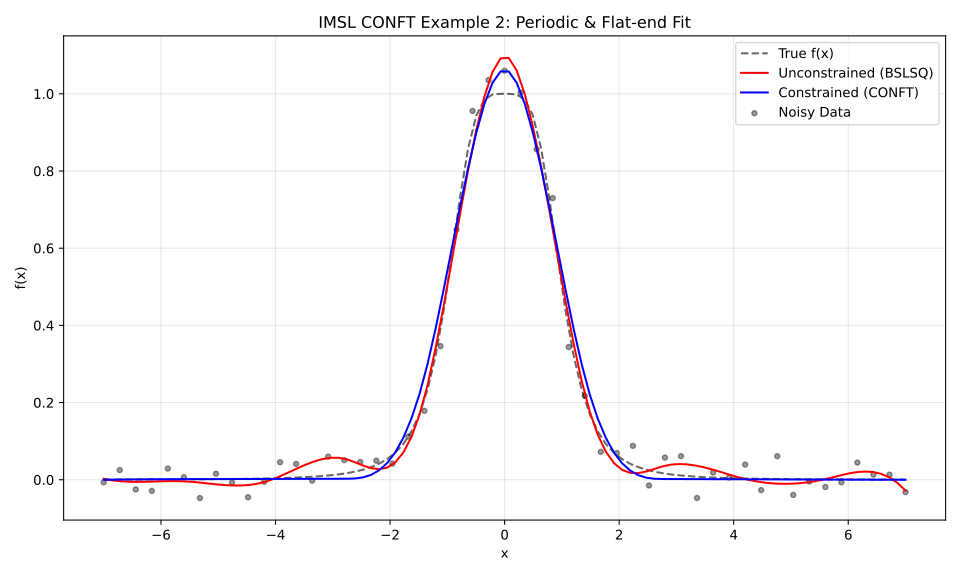
- SVG plot: tests/test_output/demo_imsl_conft_monotone.svg
"""

from __future__ import annotations

from pathlib import Path
from typing import Any, Dict
import sys

import matplotlib.pyplot as plt
import numpy as np

# Allow running this file directly without requiring external PYTHONPATH setup.
REPO_ROOT = Path(__file__).resolve().parent.parent
if str(REPO_ROOT) not in sys.path:
    sys.path.insert(0, str(REPO_ROOT))

from interpolation import (
    BSplineRepresentation,
    bspline_evaluate,
    least_squares_bspline_constrained,
    least_squares_bspline_fixed_knots,
)
from interpolation.core import _bspline_basis  # private internal helper


def run_demo_imsl_conft_monotone() -> Dict[str, Any]:
    """Run CONFT monotone fit demo and save comparison plot."""
    # Seed for reproducibility (aligns roughly with IMSL RNSET if possible,
    # but we use standard numpy seed)
    np.random.seed(234579)

    korder = 4
    ncoef = 8
    ndata = 15
    grdsiz = 10.0

    def f_true(x):
        return 0.5 * x + np.sin(0.5 * x)

    # Generate data with noise
    x_data = np.linspace(0.0, grdsiz, ndata)
    # IMSL: FDATA(I) = F1(XDATA(I)) + (FDATA(I)-.5) where FDATA is RNUNF
    noise = np.random.uniform(0.0, 1.0, ndata) - 0.5
    f_data = f_true(x_data) + noise

    # Knots: IMSL computes interior knots based on NCOEF - KORDER + 2 breakpoints
    # For NCOEF=8, KORDER=4, this is 8-4+2=6 breakpoints (0 to 10)
    # result: [0, 2, 4, 6, 8, 10]
    n_breakpoints = ncoef - korder + 2
    inner_breaks = np.linspace(0.0, grdsiz, n_breakpoints)
    knots = np.concatenate(
        ([inner_breaks[0]] * (korder - 1), inner_breaks, [inner_breaks[-1]] * (korder - 1))
    )

    # 1. Unconstrained B-spline LSQ fit
    # Note: least_squares_bspline_fixed_knots should return BSplineRepresentation
    bs_lsq = least_squares_bspline_fixed_knots(x_data, f_data, knots, korder)

    # 2. Constrained fit (Monotone: f' >= 0)
    nxval = 15
    x_val = np.linspace(0.0, grdsiz, nxval)
    n_coeff = len(knots) - korder

    # In this implementation, we must provide the constraint matrix and RHS directly
    # for least_squares_bspline_constrained.
    # Derivative order 1 constraints at x_val
    def bspline_deriv_basis(i, k, t, x):
        eps = 1e-6
        return (_bspline_basis(i, k, t, x + eps) - _bspline_basis(i, k, t, x - eps)) / (2 * eps)

    c_mat = np.zeros((nxval, n_coeff))
    for i, xi in enumerate(x_val):
        for j in range(n_coeff):
            c_mat[i, j] = bspline_deriv_basis(j, korder, knots, xi)

    # This CONFT analogue enforces equalities only, so we approximate monotonicity
    # by steering derivatives toward the nonnegative part of the unconstrained fit.
    # A moderate penalty avoids over-constraining the LSQ problem.
    slope_eps = 1e-4
    c_rhs = np.asarray(
        [
            max(
                0.0,
                (
                    bspline_evaluate(bs_lsq, float(xi + slope_eps))
                    - bspline_evaluate(bs_lsq, float(xi - slope_eps))
                )
                / (2.0 * slope_eps),
            )
            for xi in x_val
        ],
        dtype=float,
    )

    bs_conft = least_squares_bspline_constrained(
        x_data, f_data, knots, korder, constraints_matrix=c_mat, constraints_rhs=c_rhs, penalty=10.0
    )

    # Evaluation for error comparison
    x_eval = np.linspace(0.0, grdsiz, 100)
    y_true = f_true(x_eval)

    # Handle bspline_evaluate returning array or scalar
    y_lsq = np.asarray([bspline_evaluate(bs_lsq, xi) for xi in x_eval])
    y_conft = np.asarray([bspline_evaluate(bs_conft, xi) for xi in x_eval])

    avg_err_lsq = np.mean(np.abs(y_true - y_lsq))
    avg_err_conft = np.mean(np.abs(y_true - y_conft))

    print(f"\nIMSL CONFT Example 1 Parity")
    print(f"Average error with unconstrained fit: {avg_err_lsq:.5f}")
    print(f"Average error with monotone fit:      {avg_err_conft:.5f}")

    # Plotting
    output_dir = Path("test_output")
    output_dir.mkdir(parents=True, exist_ok=True)
    output_path = output_dir / "demo_imsl_conft_monotone.svg"

    fig, ax = plt.subplots(figsize=(9, 6))
    ax.plot(x_eval, y_true, "k--", alpha=0.6, label="True f(x)")
    ax.plot(x_eval, y_lsq, color="red", label="Unconstrained (BSLSQ)")
    ax.plot(x_eval, y_conft, color="blue", label="Constrained (CONFT)")
    ax.scatter(x_data, f_data, color="black", s=20, label="Noisy Data")

    ax.set_title("IMSL CONFT Example 1: Monotone B-Spline Fit")
    ax.set_xlabel("x")
    ax.set_ylabel("f(x)")
    ax.legend()
    ax.grid(True, alpha=0.3)

    fig.tight_layout()
    fig.savefig(output_path)
    plt.close(fig)

    return {
        "avg_err_lsq": avg_err_lsq,
        "avg_err_conft": avg_err_conft,
        "plot_path": str(output_path),
    }


if __name__ == "__main__":
    run_demo_imsl_conft_monotone()
Input (Console)
Run the constraint scripts from the package root:
python examples/example_imsl_conft_1.py
python examples/example_imsl_conft_2.py
Plot Output
Generated SVG plots:
Output Console
Summary console output:
script                   input setup                              representative numeric outputs
example_imsl_conft_1.py  monotone constraints on [0,10]           average unconstrained error = 0.1100303928219149; average constrained error = 0.1147826851898706
example_imsl_conft_2.py  periodic and flat constraints on [-7,7]  average unconstrained error = 0.01893213473141974; average constrained error = 0.01390170332275927
Detailed integration result tables:
CONFT integration output
example                avg_error_unconstrained  avg_error_constrained
CONFT-1 monotone            0.1100303928219149     0.1147826851898706
CONFT-2 periodic-flat      0.01893213473141974    0.01390170332275927