Monte Carlo Example — Quasi-Monte Carlo Integration
This example demonstrates integrationdifferentiation.integrate_monte_carlo()
(IMSL QMC — Halton quasi-random sampling):
Estimate \(\pi\) by integrating the unit-circle indicator \(f(x,y) = \mathbf{1}[x^2+y^2 \le 1]\) over \([-1,1]^2\) (exact: \(\pi \approx 3.14159\))
Integrate \(g(x) = e^{-x^2}\) over \([0,3]\) (exact: \(\mathrm{erf}(3)\,\sqrt{\pi}/2 \approx 0.88621\))
Show convergence of both estimates as \(N\) grows from 100 to 100 000
Example Code
"""IMSL QMC example: quasi-Monte Carlo integration.

Demonstrates :func:`integrationdifferentiation.integrate_monte_carlo`
(IMSL QMC / Halton quasi-random sampling):

- Estimate π by integrating the indicator ``f(x,y) = 1 if x²+y²≤1`` over
  ``[-1, 1]²``.  Exact answer: π ≈ 3.14159.
- Integrate ``g(x) = exp(-x²)`` over ``[0, 3]`` via Monte Carlo.
  Exact answer: ``erf(3) * √π / 2 ≈ 0.88623``.
- Show convergence as ``N`` increases from 100 to 100 000.

Outputs:
- Convergence table printed to stdout
- SVG plot saved to ``test_output/example_imsl_monte_carlo.svg``
"""

from __future__ import annotations

from pathlib import Path
from typing import Dict, List

import matplotlib.pyplot as plt
import numpy as np

from integrationdifferentiation import integrate_monte_carlo


def run_demo_imsl_monte_carlo() -> Dict[str, object]:
    """Run quasi-Monte Carlo convergence study.

    Args:
        None

    Returns:
        Dict[str, object]: Keys ``pi_estimates`` (list), ``gauss_estimates`` (list),
            ``n_vals`` (list), ``plot_path`` (str).
    """
    from scipy.special import erf

    exact_pi = np.pi
    exact_gauss = float(erf(3.0) * np.sqrt(np.pi) / 2.0)

    n_vals: List[int] = [100, 300, 1000, 3000, 10000, 30000, 100000]

    pi_estimates: List[float] = []
    gauss_estimates: List[float] = []
    pi_errors: List[float] = []
    gauss_errors: List[float] = []

    # --- circle indicator: 4 * ∫_{-1}^{1} ∫_{-1}^{1} I(x²+y²≤1) dx dy = π
    def circle_indicator(xy: np.ndarray) -> float:
        return 1.0 if float(xy[0]) ** 2 + float(xy[1]) ** 2 <= 1.0 else 0.0

    # --- Gaussian integrand: x can be a float (1D MC fallback) or array
    def gauss_func(x) -> float:
        val = float(x[0]) if hasattr(x, "__len__") else float(x)
        return float(np.exp(-val ** 2))

    print("\nIMSL QMC Example: Monte Carlo Integration")
    print("=" * 70)
    print(f"{'N':>8}  {'π estimate':>12}  {'|Δπ|':>10}  {'Gauss est.':>12}  {'|ΔG|':>10}")
    print("-" * 70)

    for n in n_vals:
        # QMC integrates the indicator over [-1,1]²: result = area_of_circle = π
        r_pi = integrate_monte_carlo(circle_indicator, [(-1.0, 1.0), (-1.0, 1.0)], n_points=n, seed=42)
        pi_est = r_pi.value
        pi_err = abs(pi_est - exact_pi)
        pi_estimates.append(pi_est)
        pi_errors.append(pi_err)

        # Gaussian integral estimate
        r_g = integrate_monte_carlo(gauss_func, [(0.0, 3.0)], n_points=n, seed=7)
        g_est = r_g.value
        g_err = abs(g_est - exact_gauss)
        gauss_estimates.append(g_est)
        gauss_errors.append(g_err)

        print(f"{n:>8}  {pi_est:>12.7f}  {pi_err:>10.3e}  {g_est:>12.7f}  {g_err:>10.3e}")

    print("=" * 70)
    print(f"{'Exact':>8}  {exact_pi:>12.7f}  {'—':>10}  {exact_gauss:>12.7f}  {'—':>10}")

    # ----------------------------------------------------------------- plots
    output_dir = Path("test_output")
    output_dir.mkdir(parents=True, exist_ok=True)
    plot_path = output_dir / "example_imsl_monte_carlo.svg"

    fig, axes = plt.subplots(1, 3, figsize=(16, 5))

    n_arr = np.array(n_vals, dtype=float)

    # Panel 1: π estimate convergence
    ax = axes[0]
    ax.semilogx(n_arr, pi_estimates, "o-", color="#1d4ed8", lw=2.0, ms=6, label="QMC estimate of π")
    ax.axhline(exact_pi, color="#dc2626", lw=1.5, ls="--", label=f"π = {exact_pi:.5f}")
    ax.set_xlabel("N (sample points)")
    ax.set_ylabel("Estimate of π")
    ax.set_title("Monte Carlo estimation of π")
    ax.legend(fontsize=9)
    ax.grid(True, alpha=0.3)

    # Panel 2: Gaussian convergence
    ax = axes[1]
    ax.semilogx(n_arr, gauss_estimates, "s-", color="#059669", lw=2.0, ms=6, label=r"QMC: $\int_0^3 e^{-x^2}dx$")
    ax.axhline(exact_gauss, color="#dc2626", lw=1.5, ls="--", label=f"Exact = {exact_gauss:.5f}")
    ax.set_xlabel("N (sample points)")
    ax.set_ylabel("Estimate")
    ax.set_title(r"Monte Carlo: $\int_0^3 e^{-x^2}\,dx$")
    ax.legend(fontsize=9)
    ax.grid(True, alpha=0.3)

    # Panel 3: absolute error convergence (log-log)
    ax = axes[2]
    ax.loglog(n_arr, pi_errors, "o-", color="#1d4ed8", lw=2.0, ms=6, label="|error π|")
    ax.loglog(n_arr, gauss_errors, "s-", color="#059669", lw=2.0, ms=6, label="|error Gauss|")
    # Theoretical N^{-1} reference line
    ref = pi_errors[0] * (n_arr[0] / n_arr)
    ax.loglog(n_arr, ref, "k--", lw=1.0, alpha=0.5, label=r"$\propto N^{-1}$")
    ax.set_xlabel("N (sample points)")
    ax.set_ylabel("Absolute error")
    ax.set_title("Error convergence (log-log)")
    ax.legend(fontsize=9)
    ax.grid(True, alpha=0.3, which="both")

    fig.suptitle("IMSL QMC: Quasi-Monte Carlo Integration", fontsize=13, fontweight="bold")
    fig.tight_layout()
    fig.savefig(plot_path, format="svg")
    plt.close(fig)

    return {
        "n_vals": n_vals,
        "pi_estimates": pi_estimates,
        "gauss_estimates": gauss_estimates,
        "plot_path": str(plot_path),
    }


if __name__ == "__main__":
    run_demo_imsl_monte_carlo()
Plot Output
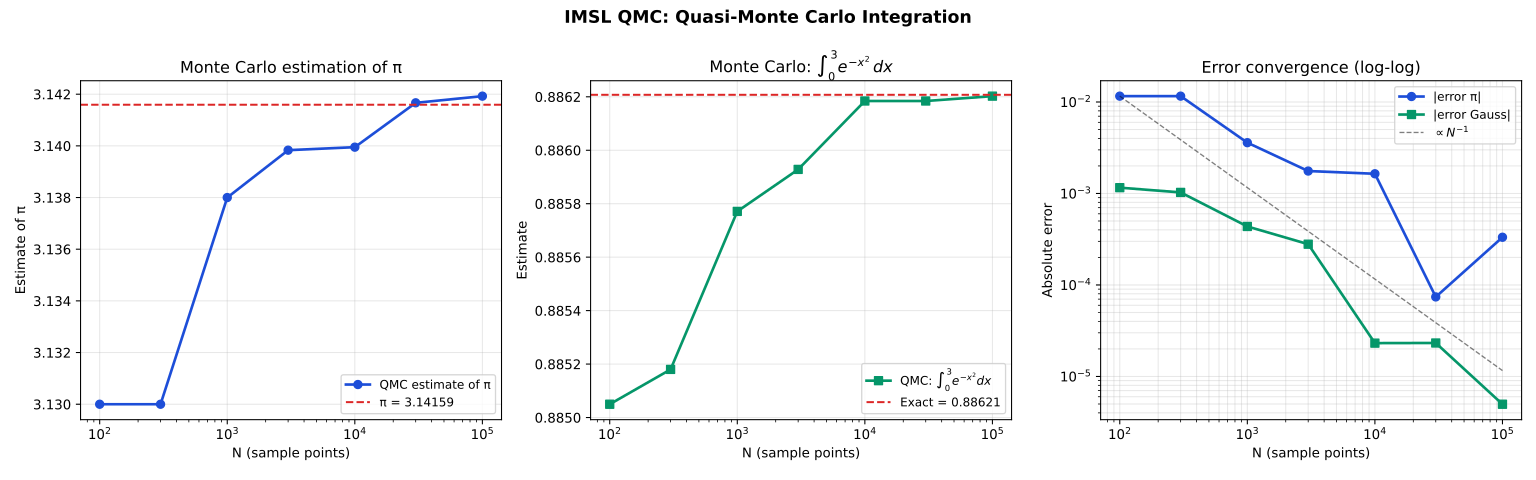
Left: estimate of \(\pi\) vs. sample size \(N\) (semi-log scale). Centre: estimate of \(\int_0^3 e^{-x^2}\,dx\) vs. \(N\). Right: log–log absolute error for both estimates with an \(N^{-1}\) reference line.
Console Output
IMSL QMC Example: Monte Carlo Integration
======================================================================
       N    π estimate        |Δπ|    Gauss est.        |ΔG|
----------------------------------------------------------------------
     100     3.1300000   1.159e-02     0.8850498   1.158e-03
     300     3.1300000   1.159e-02     0.8851801   1.027e-03
    1000     3.1380000   3.593e-03     0.8857713   4.361e-04
    3000     3.1398333   1.759e-03     0.8859282   2.791e-04
   10000     3.1399500   1.643e-03     0.8861842   2.314e-05
   30000     3.1416667   7.401e-05     0.8861841   2.322e-05
  100000     3.1419250   3.323e-04     0.8862024   4.968e-06
======================================================================
   Exact     3.1415927           ΓÇö     0.8862073           ΓÇö