Improper Integrals Example — Infinite-Domain Quadrature
This example demonstrates integrationdifferentiation.integrate_adaptive_infinite(),
integrationdifferentiation.integrate_weighted_fourier(), and
integrationdifferentiation.integrate_adaptive_endpoint_singular()
(IMSL QDAGI / QDAWF / QDAGS):
\(\int_0^\infty e^{-x^2}\,dx = \sqrt{\pi}/2 \approx 0.88623\)
\(\int_0^\infty \frac{\sin x}{x}\,dx = \pi/2 \approx 1.57080\) (Dirichlet integral via weighted Fourier)
\(\int_0^1 \frac{\ln x}{\sqrt{x}}\,dx = -4\) (endpoint singularity at \(x = 0\))
Example Code
"""IMSL QDAGI example: improper integrals over infinite domains.

Demonstrates :func:`integrationdifferentiation.integrate_adaptive_infinite`
and :func:`integrationdifferentiation.integrate_adaptive_endpoint_singular`
(IMSL QDAGI / QDAGS):

- ``∫₀^∞ exp(-x²) dx  = √π/2  ≈ 0.88623``
- ``∫₀^∞ sin(x)/x dx  = π/2   ≈ 1.57080``  (Dirichlet integral)
- ``∫₀^1 ln(x)/√x dx  = −4``               (endpoint singularity at x=0)

Outputs:
- Table printed to stdout
- SVG plot saved to ``test_output/example_imsl_improper_integrals.svg``
"""

from __future__ import annotations

from pathlib import Path
from typing import Dict

import matplotlib.pyplot as plt
import numpy as np

from integrationdifferentiation import (
    integrate_adaptive,
    integrate_adaptive_infinite,
    integrate_adaptive_endpoint_singular,
    integrate_weighted_fourier,
)


def run_demo_imsl_improper_integrals() -> Dict[str, object]:
    """Run three improper integral examples and visualise convergence.

    Args:
        None

    Returns:
        Dict[str, object]: Keys ``results`` (list of dicts with value/exact/error),
            ``plot_path`` (str).
    """
    # ---------------------------------------------------------------- case 1
    # ∫₀^∞ exp(-x²) dx = √π / 2
    def f1(x: float) -> float:
        return float(np.exp(-float(x) ** 2))

    r1 = integrate_adaptive_infinite(f1, a=0.0, b=np.inf)
    exact1 = float(np.sqrt(np.pi) / 2.0)

    # ---------------------------------------------------------------- case 2
    # ∫₀^∞ sin(x)/x dx = π/2  — use weighted Fourier quadrature for precision
    # Write as ∫_{ε}^∞ (1/x) * sin(1*x) dx ≈ π/2 (missing strip [0,ε] ≈ ε)
    def one_over_x(x: float) -> float:
        x = float(x)
        return 1.0 / x if x > 1e-12 else 1.0

    r2 = integrate_weighted_fourier(one_over_x, a=1e-10, omega=1.0, weight="sin")
    exact2 = float(np.pi / 2.0)

    # ---------------------------------------------------------------- case 3
    # ∫₀^1 ln(x)/√x dx = -4  (endpoint singularity: ln(x)→-∞ as x→0+)
    def f3(x: float) -> float:
        x = float(x)
        if x <= 0.0:
            return 0.0
        return float(np.log(x) / np.sqrt(x))

    r3 = integrate_adaptive_endpoint_singular(f3, a=0.0, b=1.0)
    exact3 = -4.0

    cases = [
        {"label": "∫₀^∞ exp(-x²) dx", "result": r1, "exact": exact1},
        {"label": "∫₀^∞ sin(x)/x dx", "result": r2, "exact": exact2},
        {"label": "∫₀^1 ln(x)/√x dx", "result": r3, "exact": exact3},
    ]

    print("\nIMSL QDAGI Example: Improper Integrals")
    print("=" * 78)
    print(f"{'Integral':<26} {'Result':>12} {'Error':>12} {'Exact':>12} {'|Δ|':>12}")
    print("-" * 78)
    for c in cases:
        r = c["result"]
        delta = abs(r.value - c["exact"])
        print(
            f"{c['label']:<26} {r.value:>12.8f} {r.error:>12.2e}"
            f" {c['exact']:>12.8f} {delta:>12.2e}"
        )
    print("=" * 78)

    # -------------------------------------------------------- convergence data
    # Show how partial integrals ∫₀^T converge as T grows for case 1 and 2
    T_vals = np.linspace(0.5, 15.0, 60)

    partial1 = []
    for T in T_vals:
        res = integrate_adaptive_infinite(f1, a=0.0, b=float(T))
        partial1.append(res.value)

    partial2 = []
    def sinc_safe(x: float) -> float:
        x = float(x)
        return 1.0 if x < 1e-12 else float(np.sin(x) / x)
    for T in T_vals:
        res = integrate_adaptive(sinc_safe, 1e-8, float(T))
        partial2.append(res.value)

    # ----------------------------------------------------------------- plots
    output_dir = Path("test_output")
    output_dir.mkdir(parents=True, exist_ok=True)
    plot_path = output_dir / "example_imsl_improper_integrals.svg"

    fig, axes = plt.subplots(1, 3, figsize=(15, 5))

    # --- panel 1: exp(-x²) integrand
    ax = axes[0]
    x1 = np.linspace(0, 4, 400)
    ax.plot(x1, np.exp(-x1 ** 2), color="#059669", lw=2.0, label=r"$e^{-x^2}$")
    ax.fill_between(x1, np.exp(-x1 ** 2), alpha=0.2, color="#059669")
    ax.axhline(0, color="black", lw=0.6)
    ax.set_xlabel("x")
    ax.set_title(r"$\int_0^\infty e^{-x^2}\,dx = \sqrt{\pi}/2$")
    ax.legend()
    ax.grid(True, alpha=0.3)
    ax.annotate(
        f"Numerical: {r1.value:.6f}\nExact:     {exact1:.6f}",
        xy=(0.97, 0.95), xycoords="axes fraction", ha="right", va="top",
        fontsize=8, bbox=dict(boxstyle="round,pad=0.3", fc="#ecfdf5", ec="#a7f3d0"),
    )

    # --- panel 2: sin(x)/x integrand
    ax = axes[1]
    x2 = np.linspace(1e-4, 20, 800)
    ax.plot(x2, np.sin(x2) / x2, color="#2563eb", lw=2.0, label=r"$\sin(x)/x$")
    ax.axhline(0, color="black", lw=0.6)
    ax.set_xlabel("x")
    ax.set_title(r"$\int_0^\infty \frac{\sin x}{x}\,dx = \pi/2$")
    ax.legend()
    ax.grid(True, alpha=0.3)
    ax.annotate(
        f"Numerical: {r2.value:.6f}\nExact:     {exact2:.6f}",
        xy=(0.97, 0.95), xycoords="axes fraction", ha="right", va="top",
        fontsize=8, bbox=dict(boxstyle="round,pad=0.3", fc="#eff6ff", ec="#bfdbfe"),
    )

    # --- panel 3: partial integral convergence
    ax = axes[2]
    ax.plot(T_vals, partial1, color="#059669", lw=2.0, label=r"$\int_0^T e^{-x^2}$")
    ax.axhline(exact1, color="#059669", lw=1.0, ls="--", alpha=0.6, label=f"exact={exact1:.5f}")
    ax.plot(T_vals, partial2, color="#2563eb", lw=2.0, label=r"$\int_{0^+}^T \sin(x)/x$")
    ax.axhline(exact2, color="#2563eb", lw=1.0, ls="--", alpha=0.6, label=f"exact={exact2:.5f}")
    ax.set_xlabel("Upper limit T")
    ax.set_ylabel("Partial integral")
    ax.set_title("Convergence of partial integrals")
    ax.legend(fontsize=8)
    ax.grid(True, alpha=0.3)

    fig.suptitle("IMSL QDAGI: Improper Integrals", fontsize=13, fontweight="bold")
    fig.tight_layout()
    fig.savefig(plot_path, format="svg")
    plt.close(fig)

    return {"results": cases, "plot_path": str(plot_path)}


if __name__ == "__main__":
    run_demo_imsl_improper_integrals()
Plot Output
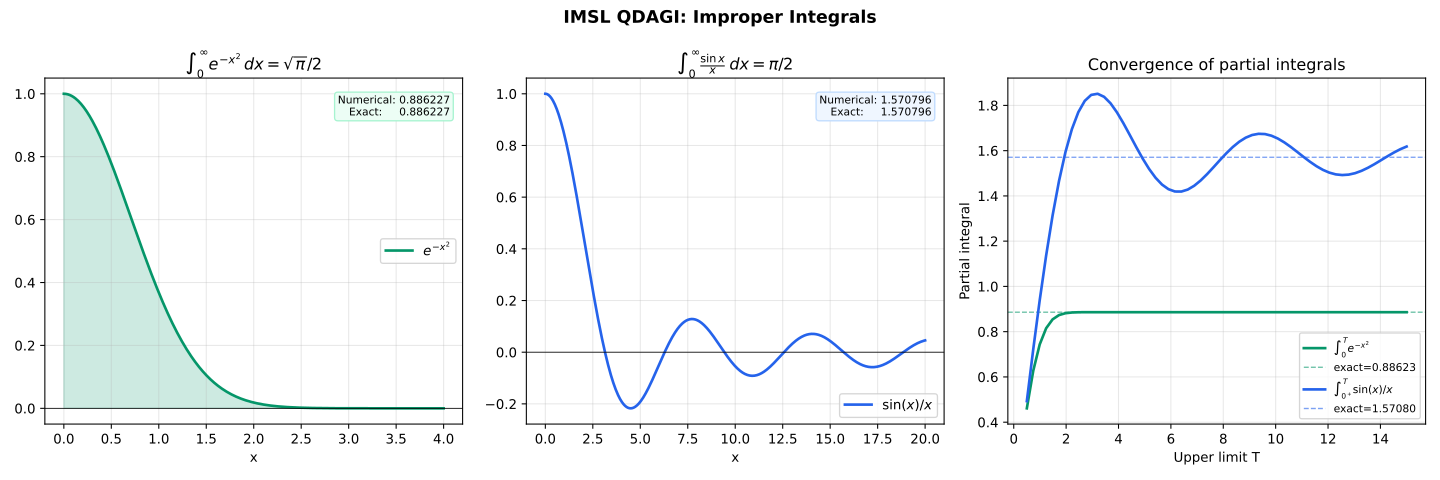
Left: \(e^{-x^2}\) integrand with shaded area. Centre: \(\sin(x)/x\) integrand. Right: convergence of partial integrals \(\int_0^T\) as the upper limit \(T\) increases.
Console Output
IMSL QDAGI Example: Improper Integrals
==============================================================================
Integral                         Result        Error        Exact          |Δ|
------------------------------------------------------------------------------
∫₀^∞ exp(-x²) dx             0.88622693     7.10e-09   0.88622693     0.00e+00
∫₀^∞ sin(x)/x dx             1.57079633     3.83e-09   1.57079633     1.18e-10
∫₀^1 ln(x)/√x dx            -4.00000000     1.35e-13  -4.00000000     8.53e-14
==============================================================================