NEQNJ Example — Nonlinear System with Analytic Jacobian
This example solves a 2-variable nonlinear system using an analytic Jacobian (IMSL NEQNJ):
\[ \begin{align}\begin{aligned}f_1(x, y) = x^2 + y^2 - 4 = 0 \quad \text{(circle of radius 2)}\\f_2(x, y) = xy - 1 = 0 \quad \text{(rectangular hyperbola)}\end{aligned}\end{align} \]
The analytic Jacobian:
\[\begin{split}J = \begin{pmatrix} 2x & 2y \\ y & x \end{pmatrix}\end{split}\]
is supplied directly to nonlinearequations.solve_system(), reducing
function evaluations compared to the finite-difference variant. Starting
from \((1.5, 0.5)\) and \((-1.5, -0.5)\), the solver converges to
both intersection points near \((\approx 1.9319,\, 0.5176)\) and its
symmetric counterpart.
Example Code
"""IMSL NEQNJ example: solve a nonlinear system with an analytic Jacobian.

Solves the system:
    f1(x, y) = x^2 + y^2 - 4  (circle of radius 2)
    f2(x, y) = x*y - 1

Two solutions near (1.93, 0.52) and (-1.93, -0.52).

Uses :func:`nonlinearequations.solve_system` (IMSL NEQNJ) which accepts an
explicit analytic Jacobian, reducing function evaluations versus the
finite-difference variant.

Outputs:
- Table printed to stdout
- SVG contour plot of f1=0 and f2=0 with solution marked
- Saved to test_output/example_imsl_neqnj.svg
"""

from __future__ import annotations

from pathlib import Path
from typing import Dict

import matplotlib.pyplot as plt
import numpy as np

from nonlinearequations import solve_system


def run_demo_imsl_neqnj() -> Dict[str, object]:
    """Run IMSL NEQNJ example: 2-variable nonlinear system with analytic Jacobian.

    Solves f1 = x^2 + y^2 - 4 = 0 and f2 = x*y - 1 = 0 from two different
    starting points to recover both solution branches.

    Args:
        None

    Returns:
        Dict[str, object]: Result dict with keys ``solutions`` (list of
            np.ndarray), ``fvals`` (list of float), ``n_fev`` (int), and
            ``plot_path`` (str).
    """

    def f(v: np.ndarray) -> np.ndarray:
        """System function for the nonlinear equations.

        Args:
            v (np.ndarray): Current point [x, y].

        Returns:
            np.ndarray: Residuals [f1, f2].
        """
        x, y = v[0], v[1]
        return np.array([
            x**2 + y**2 - 4.0,   # circle of radius 2
            x * y - 1.0,          # rectangular hyperbola
        ])

    def jac(v: np.ndarray) -> np.ndarray:
        """Analytic Jacobian of the system.

        Args:
            v (np.ndarray): Current point [x, y].

        Returns:
            np.ndarray: 2x2 Jacobian matrix df_i/dx_j.
        """
        x, y = v[0], v[1]
        return np.array([
            [2.0 * x,  2.0 * y],   # d(f1)/dx, d(f1)/dy
            [y,        x],          # d(f2)/dx, d(f2)/dy
        ])

    # Solve from two starting points to get both solutions
    x0_pos = np.array([1.5, 0.5])
    x0_neg = np.array([-1.5, -0.5])

    result_pos = solve_system(f, jac, x0_pos)
    result_neg = solve_system(f, jac, x0_neg)

    solutions = [result_pos.x, result_neg.x]
    fvals = [result_pos.fval, result_neg.fval]
    total_fev = result_pos.n_fev + result_neg.n_fev

    print("\nIMSL NEQNJ Example: Nonlinear System with Analytic Jacobian")
    print("  System:  f1: x^2 + y^2 = 4  (circle, radius 2)")
    print("           f2: x*y = 1         (hyperbola)")
    print("-" * 60)
    print(f"{'Parameter':<30} {'Value':>20}")
    print("-" * 60)
    for i, (sol, fv) in enumerate(zip(solutions, fvals), start=1):
        print(f"{'Solution ' + str(i) + ' x':<30} {sol[0]:>20.10f}")
        print(f"{'Solution ' + str(i) + ' y':<30} {sol[1]:>20.10f}")
        print(f"{'Residual norm ' + str(i):<30} {fv:>20.2e}")
    print(f"{'Total function evals':<30} {total_fev:>20}")
    print(f"{'Both converged':<30} {str(result_pos.success and result_neg.success):>20}")
    print("-" * 60)

    # ------------------------------------------------------------------
    # Plot: contour lines f1=0 and f2=0 with solutions marked
    # ------------------------------------------------------------------
    output_dir = Path("test_output")
    output_dir.mkdir(parents=True, exist_ok=True)
    plot_path = output_dir / "example_imsl_neqnj.svg"

    x_grid = np.linspace(-2.8, 2.8, 500)
    y_grid = np.linspace(-2.8, 2.8, 500)
    X, Y = np.meshgrid(x_grid, y_grid)
    F1 = X**2 + Y**2 - 4.0
    F2 = X * Y - 1.0

    fig, ax = plt.subplots(figsize=(7, 6))
    ax.contour(X, Y, F1, levels=[0], colors=["#0e7490"], linewidths=2.0)
    ax.contour(X, Y, F2, levels=[0], colors=["#0891b2"], linewidths=2.0, linestyles="--")

    # Dummy lines for legend
    ax.plot([], [], color="#0e7490", linewidth=2.0, label=r"$f_1 = x^2 + y^2 - 4 = 0$")
    ax.plot([], [], color="#0891b2", linewidth=2.0, linestyle="--",
            label=r"$f_2 = xy - 1 = 0$")

    sol_x = [s[0] for s in solutions]
    sol_y = [s[1] for s in solutions]
    ax.scatter(sol_x, sol_y, color="#d62728", s=100, zorder=5, label="Solutions (NEQNJ)")

    for sol in solutions:
        ax.annotate(
            f"({sol[0]:.4f}, {sol[1]:.4f})",
            xy=(sol[0], sol[1]),
            xytext=(sol[0] + 0.12, sol[1] - 0.25),
            fontsize=9,
            color="#d62728",
        )

    ax.axhline(0, color="#aaaaaa", linewidth=0.7)
    ax.axvline(0, color="#aaaaaa", linewidth=0.7)
    ax.set_xlim(-2.8, 2.8)
    ax.set_ylim(-2.8, 2.8)
    ax.set_xlabel("x")
    ax.set_ylabel("y")
    ax.set_title("IMSL NEQNJ: Nonlinear System with Analytic Jacobian")
    ax.legend(loc="upper left")
    ax.grid(True, alpha=0.25)
    fig.tight_layout()
    fig.savefig(plot_path, format="svg")
    plt.close(fig)

    return {
        "solutions": solutions,
        "fvals": fvals,
        "n_fev": total_fev,
        "plot_path": str(plot_path),
    }


if __name__ == "__main__":
    run_demo_imsl_neqnj()
Plot Output
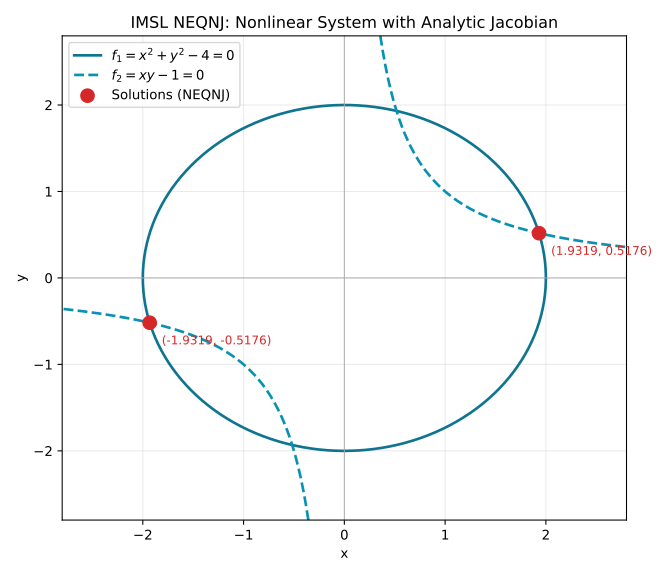
Contour lines where \(f_1 = 0\) (circle, teal) and \(f_2 = 0\) (hyperbola, dashed) intersect at the two solution points (red dots) found by the analytic-Jacobian solver.
Console Output
IMSL NEQNJ Example: Nonlinear System with Analytic Jacobian
  System:  f1: x^2 + y^2 = 4  (circle, radius 2)
           f2: x*y = 1         (hyperbola)
------------------------------------------------------------
Parameter                                     Value
------------------------------------------------------------
Solution 1 x                           1.9318516526
Solution 1 y                           0.5176380902
Residual norm 1                            6.99e-13
Solution 2 x                          -1.9318516526
Solution 2 y                          -0.5176380902
Residual norm 2                            6.99e-13
Total function evals                             22
Both converged                                 True
------------------------------------------------------------