Heat Equation Example — Method of Lines
This example solves the 1-D heat (diffusion) equation
\[\frac{\partial u}{\partial t} = \alpha\,\frac{\partial^2 u}{\partial x^2},
\quad \alpha = 0.01, \quad x \in [0, 1]\]
with Dirichlet boundary conditions \(u(0,t)=u(1,t)=0\) and the initial condition \(u(x,0)=\sin(\pi x)\).
The spatial dimension is discretized with \(N=49\) interior finite-difference
nodes (method of lines), and the resulting stiff ODE system is integrated in time
with differentialequations.ivpag() using the 'BDF' method.
The analytical solution is:
\[u(x, t) = \sin(\pi x)\,e^{-\alpha\pi^2 t}\]
Example Code
"""IMSL heat equation example: 1-D heat equation via method of lines.

Solves the 1-D heat (diffusion) equation

    ∂u/∂t = α ∂²u/∂x²,   α = 0.01

on x ∈ [0, 1] with:
  - IC:  u(x, 0) = sin(πx)
  - BC:  u(0, t) = u(1, t) = 0  (Dirichlet)

Space is discretized with N interior nodes (method of lines) and time
integration is performed with ivpag() using BDF for the resulting stiff ODE.

Analytical solution: u(x, t) = sin(πx) * exp(-α π² t)

Outputs:
- Maximum absolute error vs analytical at t_final printed to stdout
- SVG plot saved to test_output/example_imsl_heat_equation.svg
"""

from __future__ import annotations

from pathlib import Path
from typing import Dict

import matplotlib.pyplot as plt
import numpy as np

from differentialequations import ivpag


_ALPHA = 0.01
_N = 49  # interior grid points


def run_demo_imsl_heat_equation() -> Dict[str, object]:
    """Run IMSL heat equation example using method of lines with ivpag.

    Discretizes ∂u/∂t = α ∂²u/∂x² in space with N interior nodes and uses
    ivpag (BDF method) for time integration.  Compares numerics against the
    analytical solution u(x,t) = sin(πx) * exp(-α π² t).

    Args:
        None

    Returns:
        Dict[str, object]: Result dict with keys ``x`` (ndarray), ``t_plot``
            (list), ``u_numerical`` (list of ndarray), ``max_error`` (float),
            and ``plot_path`` (str).
    """
    dx = 1.0 / (_N + 1)
    x = np.linspace(dx, 1.0 - dx, _N)
    alpha_dx2 = _ALPHA / dx ** 2

    u_init = np.sin(np.pi * x)

    def heat_mol(t: float, u: np.ndarray) -> np.ndarray:
        """Method-of-lines spatial discretization of the heat equation.

        Args:
            t (float): Time (unused, autonomous in space terms).
            u (np.ndarray): Interior node temperatures of shape ``(N,)``.

        Returns:
            np.ndarray: Time derivatives du/dt of shape ``(N,)``.
        """
        dudt = np.empty_like(u)
        dudt[0] = alpha_dx2 * (-2.0 * u[0] + u[1])
        dudt[-1] = alpha_dx2 * (u[-2] - 2.0 * u[-1])
        dudt[1:-1] = alpha_dx2 * (u[:-2] - 2.0 * u[1:-1] + u[2:])
        return dudt

    t_plot_targets = [0.1, 0.5, 1.0]
    t_final = t_plot_targets[-1]

    result = ivpag(heat_mol, (0.0, t_final), u_init, method="BDF", rtol=1e-7, atol=1e-10)

    def analytical(x_arr: np.ndarray, t: float) -> np.ndarray:
        """Analytical heat equation solution for the sine initial condition.

        Args:
            x_arr (np.ndarray): Spatial positions.
            t (float): Time.

        Returns:
            np.ndarray: u(x, t) = sin(πx) * exp(-α π² t).
        """
        return np.sin(np.pi * x_arr) * np.exp(-_ALPHA * np.pi ** 2 * t)

    u_at_times = []
    for t_target in t_plot_targets:
        idx = np.argmin(np.abs(result.t - t_target))
        u_at_times.append(result.y[:, idx])

    u_final_num = result.y[:, -1]
    u_final_ana = analytical(x, t_final)
    max_error = float(np.max(np.abs(u_final_num - u_final_ana)))

    print("\nIMSL Heat Equation Example: Method of Lines with ivpag (BDF)")
    print("=" * 60)
    print(f"  α (diffusivity)  : {_ALPHA}")
    print(f"  Spatial nodes N  : {_N}  (Δx = {dx:.4f})")
    print(f"  t_final          : {t_final}")
    print(f"  IC               : u(x,0) = sin(πx)")
    print(f"  BC               : u(0,t) = u(1,t) = 0")
    print()
    print(f"  Steps taken      : {result.n_steps}")
    print(f"  Function evals   : {result.n_eval}")
    print()
    print(f"  Max |error| vs analytical at t={t_final}: {max_error:.4e}")
    print("=" * 60)

    output_dir = Path("test_output")
    output_dir.mkdir(parents=True, exist_ok=True)
    plot_path = output_dir / "example_imsl_heat_equation.svg"

    x_full = np.linspace(0, 1, 200)
    colors = ["#0369a1", "#0891b2", "#16a34a", "#e11d48"]
    t_labels = [0.0] + t_plot_targets

    fig, axes = plt.subplots(1, 2, figsize=(13, 5))

    # Left panel: solution at multiple times
    axes[0].plot(x_full, np.sin(np.pi * x_full),
                 color=colors[0], linewidth=2.0, label="t = 0  (IC)")
    for (t_val, u_num, col) in zip(t_plot_targets, u_at_times, colors[1:]):
        u_ana = analytical(x_full, t_val)
        axes[0].plot(x_full, u_ana, color=col, linewidth=1.5, linestyle="--", alpha=0.7)
        axes[0].plot(x, u_num, color=col, linewidth=2.0, label=f"t = {t_val}")
    axes[0].set_xlabel("x")
    axes[0].set_ylabel("u(x, t)")
    axes[0].set_title("1-D Heat Equation: u(x,t) at selected times\n(dashed = analytical)")
    axes[0].legend(fontsize=9)
    axes[0].grid(True, alpha=0.3)

    # Right panel: absolute error at t_final
    error = np.abs(u_final_num - u_final_ana)
    axes[1].semilogy(x, error, color="#e11d48", linewidth=2.0,
                     label=f"t = {t_final}")
    axes[1].set_xlabel("x")
    axes[1].set_ylabel(r"$|u_\mathrm{num} - u_\mathrm{ana}|$")
    axes[1].set_title(f"Absolute Error vs Analytical  (t = {t_final})\nmax error = {max_error:.2e}")
    axes[1].legend(fontsize=9)
    axes[1].grid(True, which="both", alpha=0.3)

    fig.suptitle(
        r"IMSL ivpag (BDF): 1-D Heat Equation  $\partial_t u = \alpha\,\partial_{xx}u$",
        fontsize=13, fontweight="bold"
    )
    fig.tight_layout()
    fig.savefig(plot_path, format="svg")
    plt.close(fig)

    return {
        "x": x,
        "t_plot": t_plot_targets,
        "u_numerical": u_at_times,
        "max_error": max_error,
        "plot_path": str(plot_path),
    }


if __name__ == "__main__":
    run_demo_imsl_heat_equation()
Plot Output
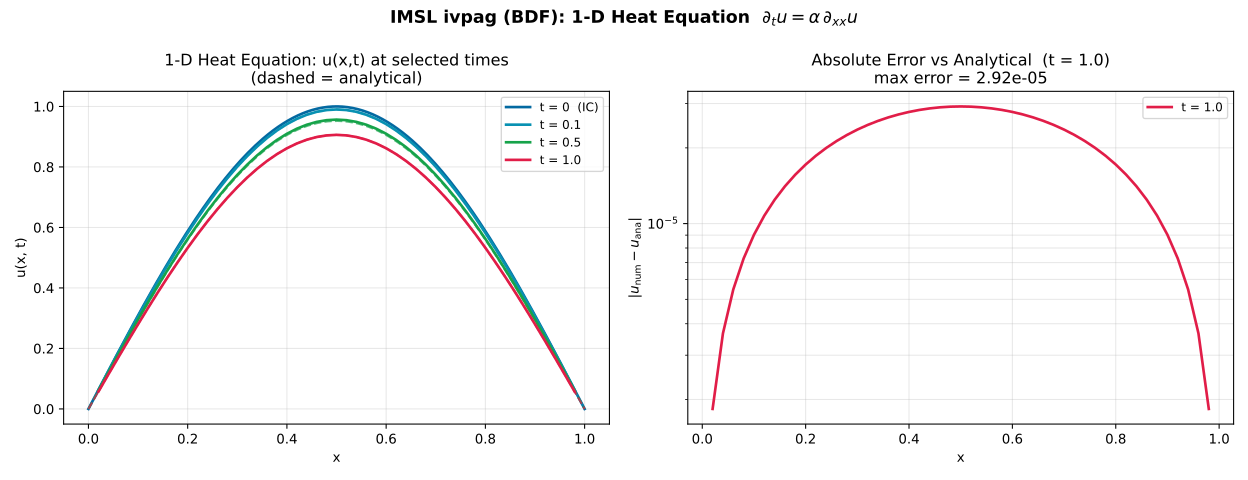
Left: numerical solution (solid) and analytical (dashed) at \(t = 0, 0.1, 0.5, 1.0\). Right: absolute pointwise error versus the analytical solution at \(t = 1.0\).
Console Output
IMSL Heat Equation Example: Method of Lines with ivpag (BDF)
============================================================
  ╬▒ (diffusivity)  : 0.01
  Spatial nodes N  : 49  (Δx = 0.0200)
  t_final          : 1.0
  IC               : u(x,0) = sin(πx)
  BC               : u(0,t) = u(1,t) = 0

  Steps taken      : 19
  Function evals   : 38

  Max |error| vs analytical at t=1.0: 2.9215e-05
============================================================